Documentation

Last updated:
Watch the full walkthrough on YouTube: Open on YouTube

1) Introduction

⚡ Quick steps
  1. Read the overview below to understand what Fractal does and who it's for.
  2. Check the Free vs Pro vs Platinum vs Diamond table at the bottom of this section to pick your plan.
  3. Head to Quick Start to get your first video exported in under 5 minutes.

Fractal Video Shufflr is a desktop app for creators who want to produce dynamic edits in minutes instead of hours. It automatically selects segments from your source footage, shuffles them with your rules, and merges the clips into an MP4. The goal is to compress the tedious parts of editing into a fast, repeatable flow—so you can focus on storytelling, sourcing, and publishing.

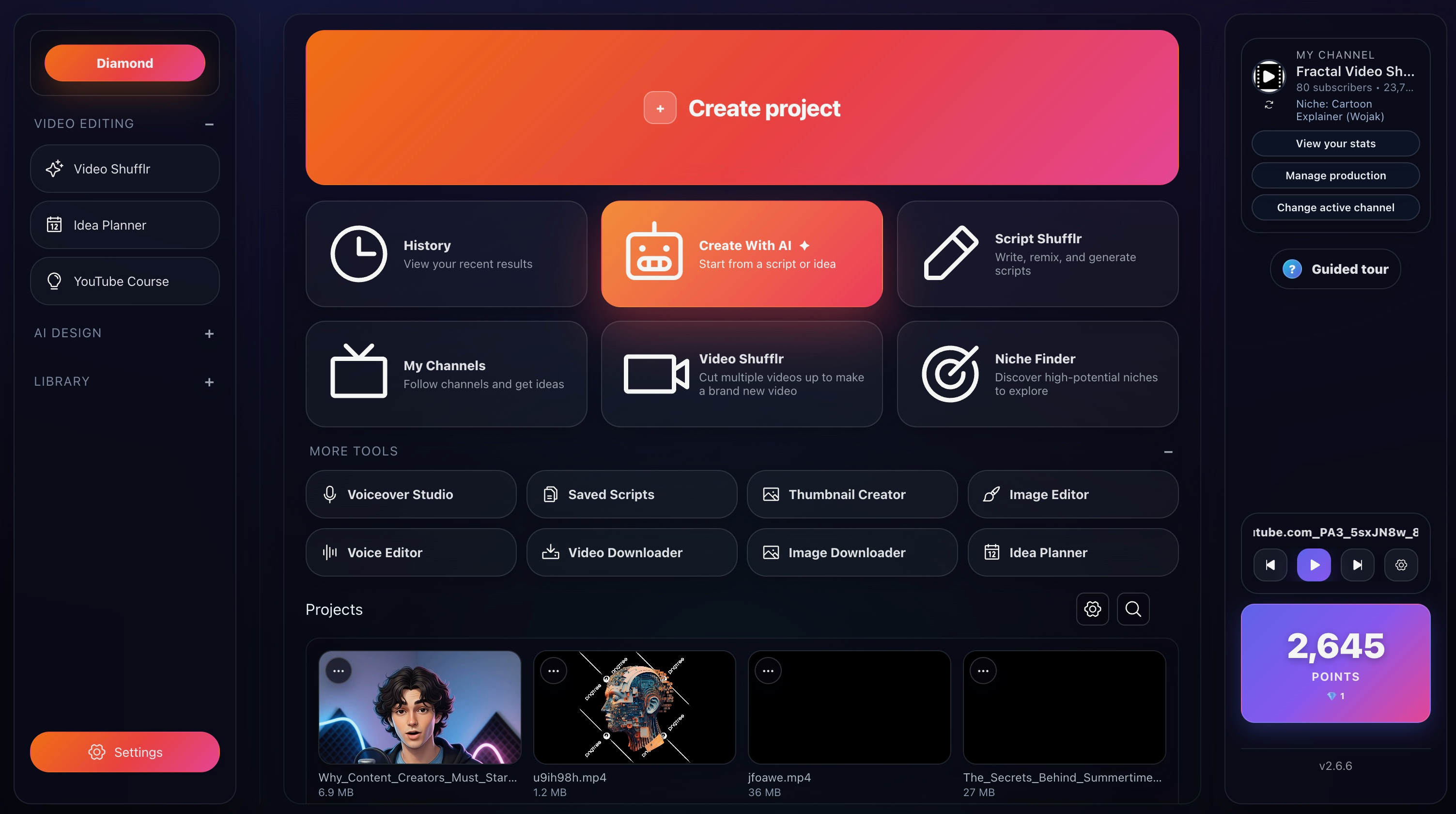
Screenshot: The homepage hub

Tip: In the app, hover over buttons and controls to see quick hints explaining what they do.

Who this is for

  • Shorts/TikTok/Reels creators who want fast, high‑tempo compilations.
  • Faceless YouTube channels that rely on curation, remixes, or commentary.
  • Long‑form editors who need b‑roll shuffles, montage sequences, or quick alternate cuts.
  • Solo creators and small teams who want predictable outputs and time savings.

What you’ll accomplish with this guide

  • Install the app on macOS or Windows.
  • Understand the UI and core workflow from file selection to final MP4 export.
  • Use Pro workflows to plan, iterate, and template edits with Pages and Review.
  • Leverage Script Shufflr for narration or voiceover drafting.
  • Research with Niche Finder and the Chrome extension to find high‑performing content.
  • Create video automatically using artificial intelligence and editing "skills".
  • Troubleshoot common issues (permissions, quotas, subscriptions, auth).
  • Apply best practices for shorts/long‑form, file organization, and performance.

Free vs Pro vs Platinum vs Diamond

Free: MP4 import, shuffle/merge pipeline, core settings, history list, updates.
Pro: WebM import, Quick settings/sliders, Pages & ordered merge, Review before merge, Script Shufflr, Niche Finder, YouTube integration, premium history controls, advanced flags, Autosave.
Platinum: Create with AI workflow, Personal Thumbnail Space, channel dashboard analytics with synced members-area access, and included AI + TTS access.
Diamond: Everything in Platinum plus built‑in diamond-only niche templates and a long‑form “one‑click” AI video workflow designed for original videos. Enables AI generated motion design.

2) Installation and system requirements

⚡ Quick steps
  1. Go to the Download page and grab the installer for your OS.
  2. macOS: Open the .dmg and drag the app into Applications, then double-click to launch.
  3. Windows: Run the installer and launch from the Start Menu.
  4. Windows: You will get a BLUE WINDOWS DEFENDER message. Click More info and then Run anyway. This is normal for new apps on Windows.

Supported platforms

  • macOS (Intel and Apple Silicon)
  • Windows 10/11

macOS installation

  1. Download the installer from Download.
  2. Open the .dmg and drag VideoShuffle.app into Applications.

Windows installation

  1. Download the installer from Download and run it.
  2. Launch Fractal Video Shufflr from the Start Menu or Desktop shortcut.

Updates

  • Auto-update: The app will automatically check for updates when it starts. You can follow below steps to update the app manually.
  • macOS: Download the latest .dmg from Download and replace the app in Applications if prompted (run the quarantine fix above only if macOS asks).
  • Windows: Delete the app from your system. Download the latest installer from Download and run it to update.

Uninstall and cleanup

  • macOS: Quit the app and delete VideoShuffle.app from Applications.
  • Windows: Uninstall from Settings → Apps or Control Panel → Programs.
  • In‑app cleanup: Use Clear All in History to remove previous project entries. Your output videos are stored in your chosen save location and won’t be deleted automatically.

Network access

  • Offline: Core shuffling/merging and editing workflows work offline.
  • Online: Pro services (Channel Dashboard, Niche Finder data, YouTube, Script Shufflr) require internet access.

Troubleshooting

  • Processing engine errors: If an export fails immediately, try restarting the app and retrying with fewer files first to confirm a clean baseline.
  • macOS can’t open the app: Run the quarantine removal command once (see above) then reopen.
  • Permissions: If selecting files or opening the save location fails, try launching the app with normal user permissions (not as root) and ensure your drive isn’t read‑only.
  • Windows auto‑update fails: If an update breaks the app, open the installation folder and run the Uninstall Fractal Video Shufflr tool (or uninstall from Settings → Apps). Then download the latest installer from the website and reinstall.

3) Quick start (5 minutes)

This is the fastest way to get your first export—no extra tools or installs required.

⚡ Quick steps
  1. Download and install the app (see Installation if needed).
  2. Open the app and click Video Shufflr on the homepage hub.
  3. Click Select Files and pick a few MP4 videos.
  4. Set Min clip: 3s, Max clip: 5s, Total: 60s — safe starting values.
  5. Click File & Export! — your first video saves automatically.

Video: Quick start walkthrough

Watch on YouTube: Open on YouTube

Step 1 — Install

  1. Download the installer from Download.
  2. macOS: Open the .dmg and drag VideoShuffle.app into Applications.
  3. Windows: Run the installer and launch the app from Start Menu/Desktop.

Step 2 — Create your first project

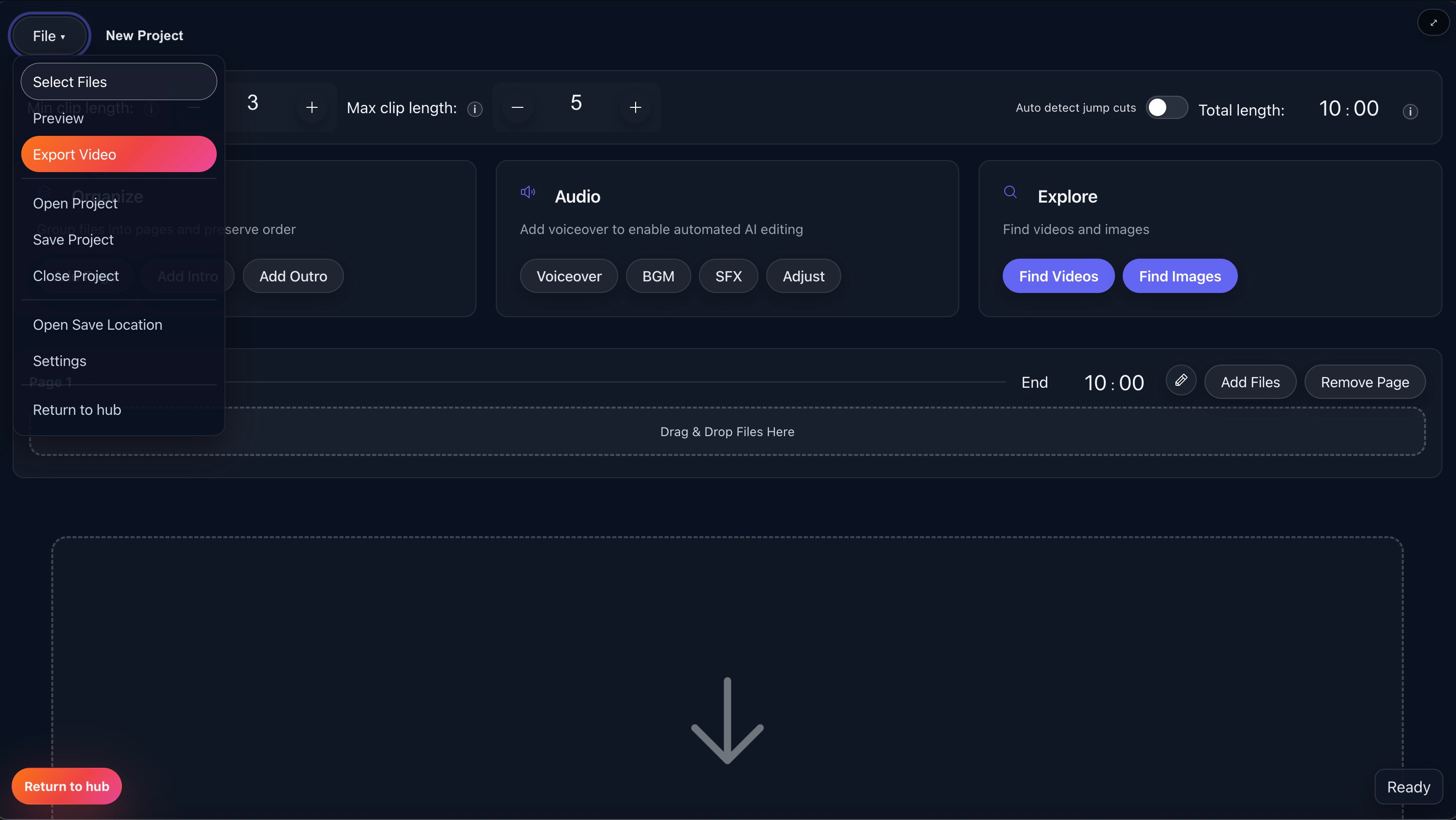
Screenshot: Adding Files
  1. Open the app and you’ll land on Home.
  2. Click Video Shufflr
  3. Click Files in the top left and then Select Files and pick a few MP4s.

Step 3 — Export

  1. Set a simple baseline: Min Clip 3s, Max Clip 5s, Total Duration 60–120s.
  2. Click File & Export!.
  3. When it finishes, click Open Save Location to find your MP4.
  4. Note: Exports are queued and will be processed in order.

Tips for a guaranteed first success

  • Start with 5–10 short MP4 clips (avoid huge 4K HDR for your first run).
  • If output is shorter than expected, increase Total Duration or use longer input clips.
  • If a specific file fails, remove it and retry—then re-add files one by one to identify the outlier.

4) Homepage Hub

⚡ Quick steps
  1. Open the app — you land on the homepage hub automatically.
  2. Use the left sidebar to navigate between Video Editing, AI Design, and Library.
  3. Click any tile to open that feature (Advanced Editor, Script Shufflr, My Channels, etc.).
  4. Click the gear icon in the sidebar to open Settings at any time.

Video: Homepage hub walkthrough

Watch on YouTube: Open on YouTube

The homepage hub (your starting point)

When you open the app, you land in the Home hub: a sidebar + tiles layout that routes you to every tool (editing, AI, research, library).

Screenshot: homepage hub Navigation
  • Sidebar navigation: Jump between Video editing, AI design, and Library sections.
  • Tiles: Big buttons for the most common actions (Create With AI, Script Shufflr, Advanced Editor, Research [Platinum], My Channels [Platinum], History).
  • More tools: Quick access buttons like Niche Finder, Voiceover Studio, and Video Downloader (Platinum).
  • Settings: Always available from the Home sidebar (gear icon).

“Create project”

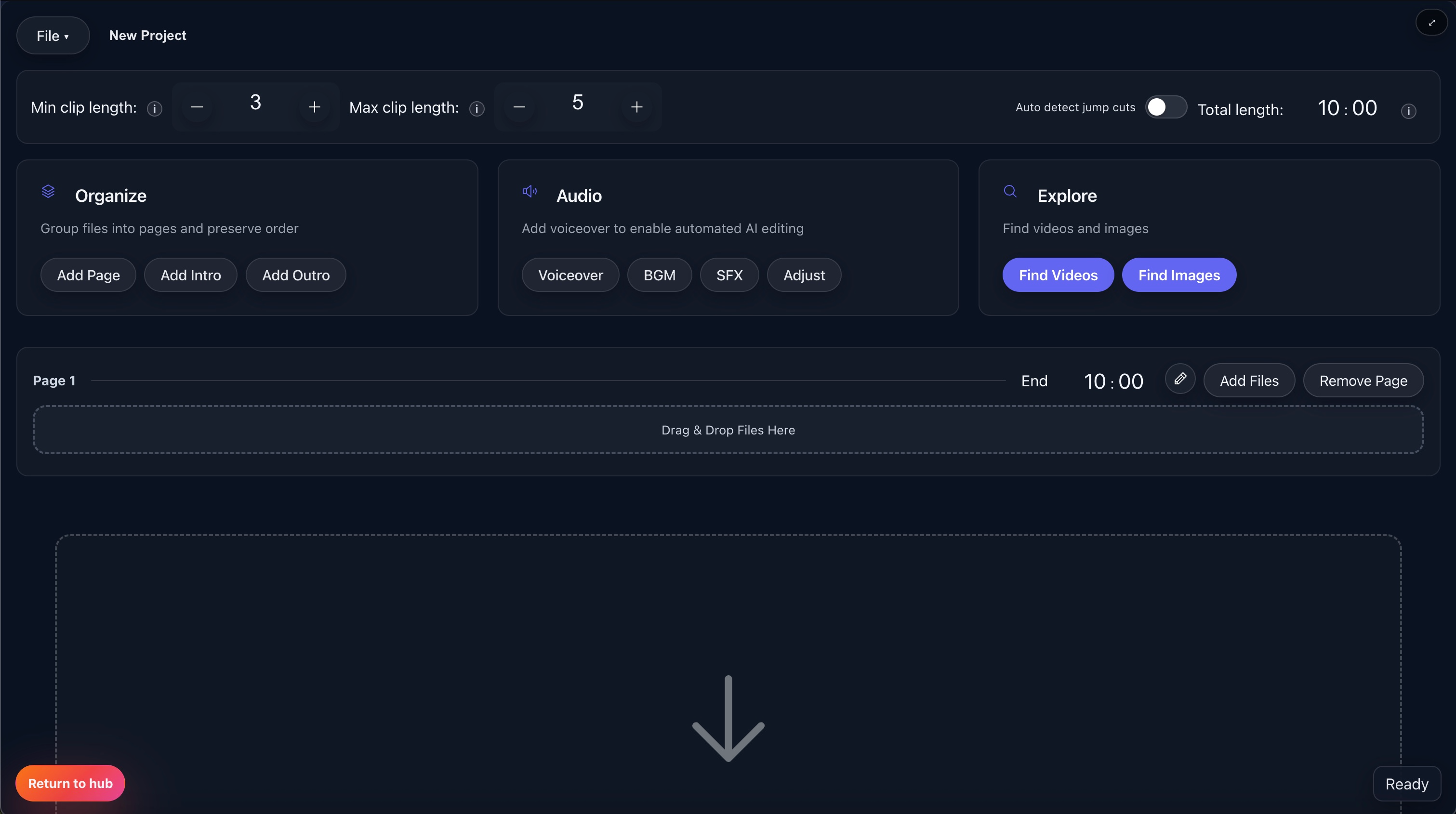
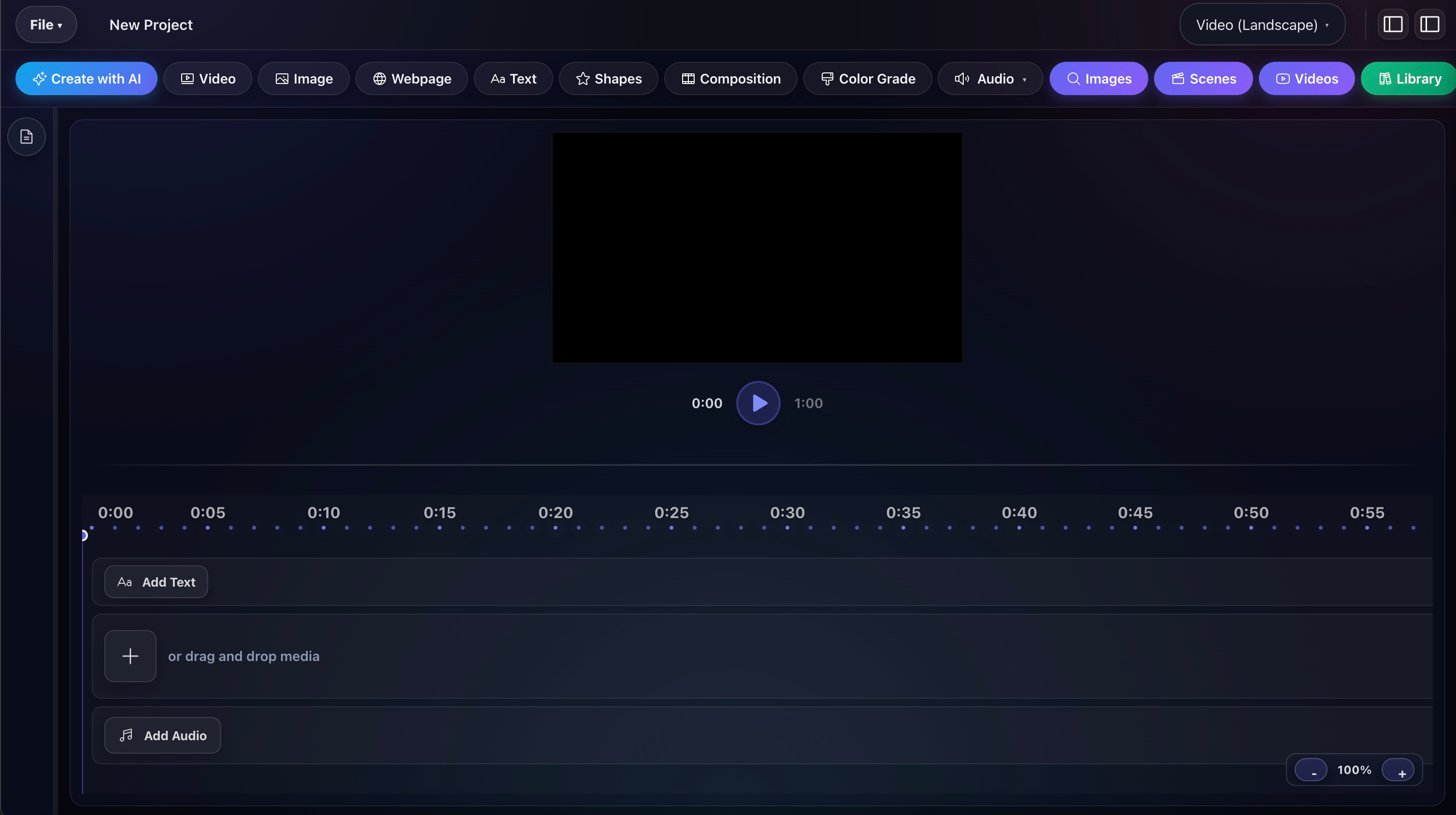
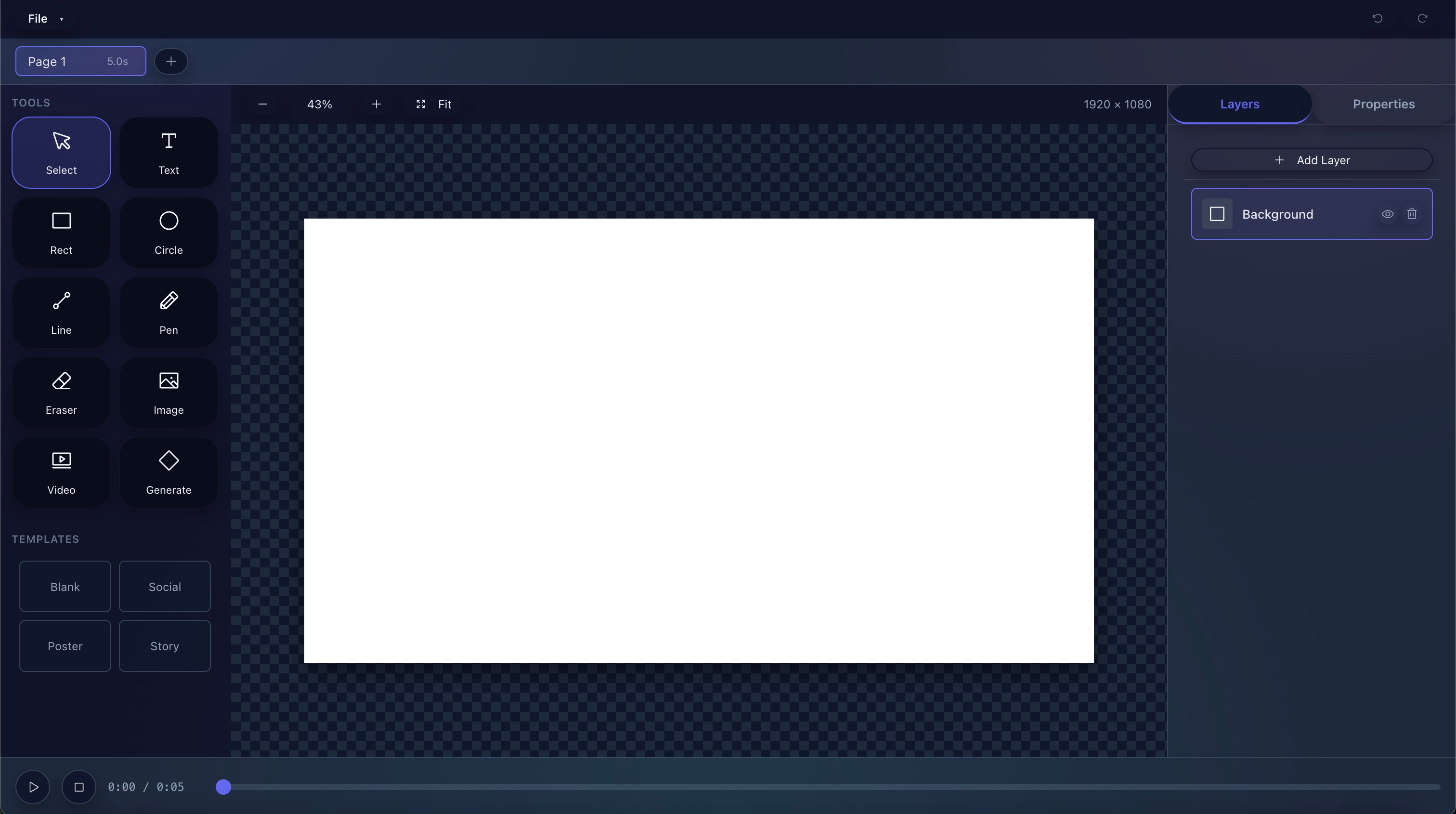
Create project opens your editing workspace in the video creator. From there you can:

  • Create video from scratch using AI - letting AI generate the script, images, and video clips
  • Create video from scratch using your own video clips
  • Create video from scratch using AI and your own video clips
  • And more!

Features

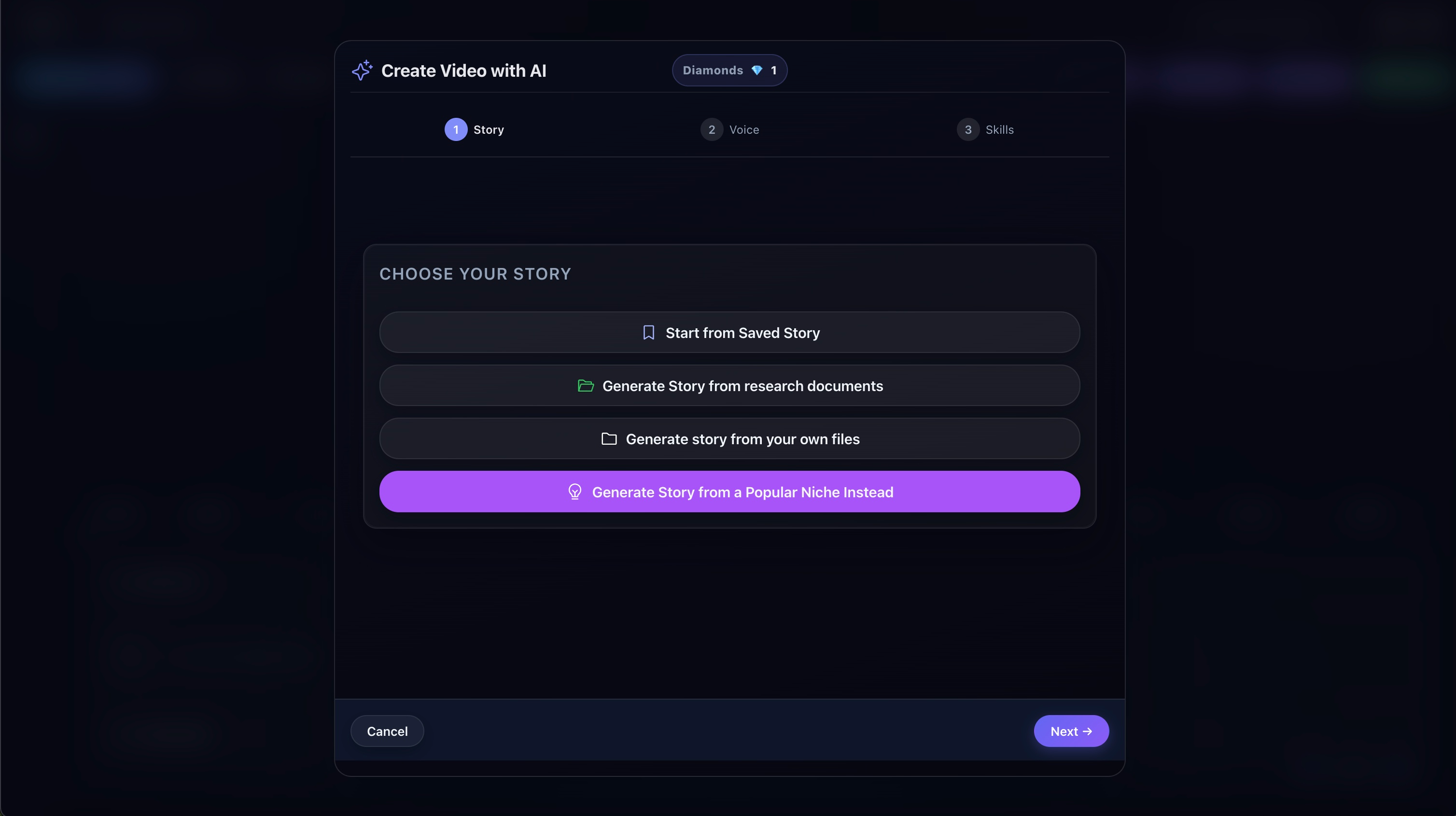
  • Create With AI: Launch from the Home tile/side nav under AI design. It generates a draft plan you can refine (see Create with AI).
  • Library: Open from the left sidebar to browse reusable prompts, assets, flows, RSS feeds, and narrators. See Library for the full system overview.
  • My Channels: Launch from the Home tile to follow channels and power idea workflows (Platinum+; see My Channels + Idea Browser).
  • Research: Launch from the Home tile to run AI-powered research on an idea/script/link.
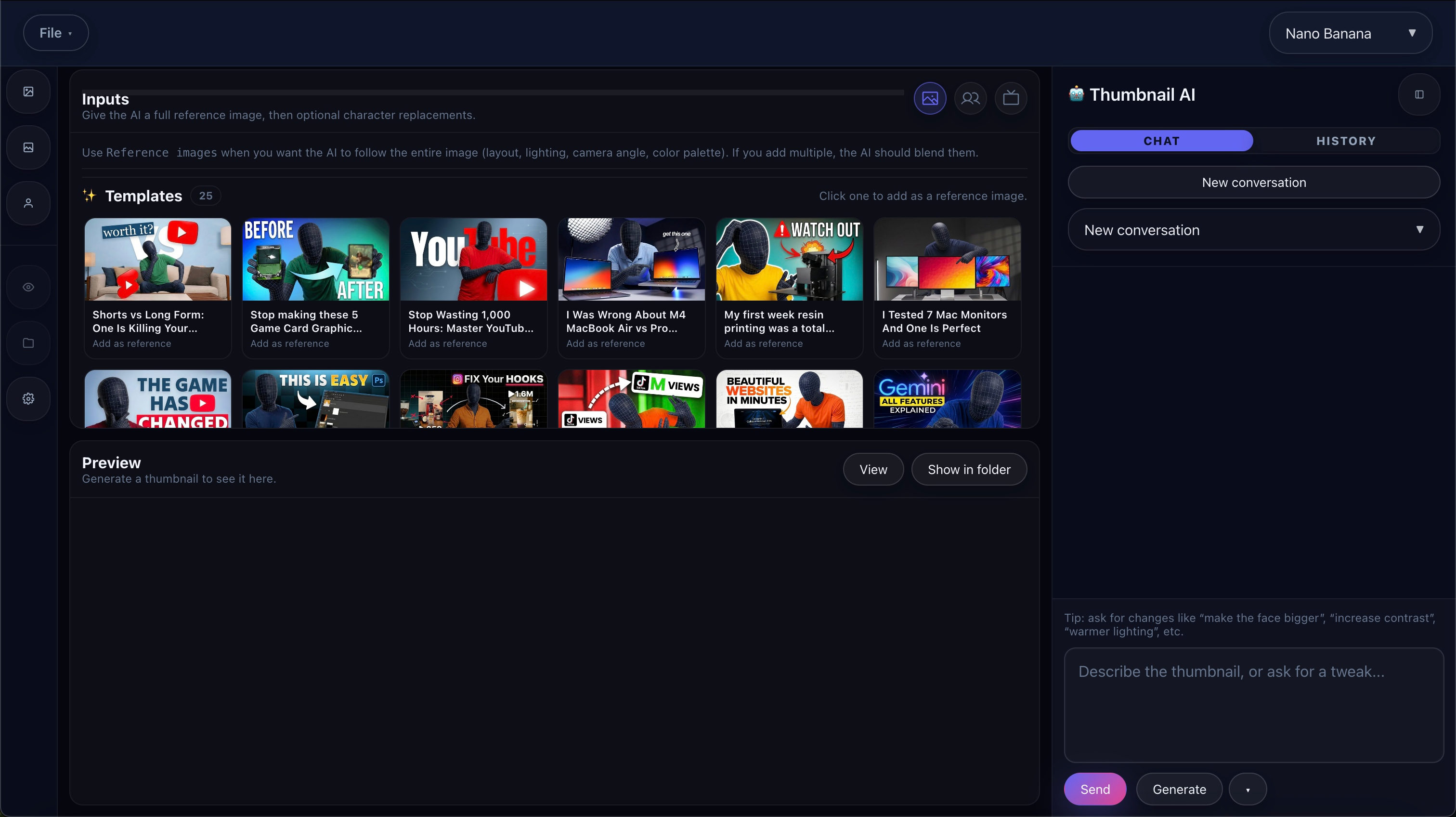
  • Music Creator / Prompt Creator / Character Studio: Launch from the Home sidebar under AI design (availability depends on plan/config).

Helpful docs shortcut: If you are learning the homepage hub, pair Library with Create with AI Skills. Those two sections explain most of the reusable systems you will revisit every day.

Status, progress, and recovery

  • Floating status: Long operations show a floating status/progress indicator so you know what’s happening.
  • Recovery paths: Use Projects, History, and autosave restore to jump back into recent work after a restart or interrupted run.
  • Clear app cache: cleans up temporary metadata files (doesn't delete your videos).

5) Library

⚡ Quick steps
  1. Open Library from the homepage hub sidebar.
  2. Switch between Assets, Prompts, Flows, RSS Feeds, and Narrators.
  3. Reuse saved items instead of rebuilding from scratch each time.
  4. Inside Video Creator, open the Library modal to import saved assets directly onto the timeline.

Video: Library system walkthrough

Watch on YouTube: Open on YouTube

Library overview

The Library is Fractal's reusable storage layer. It is where you save things you want to reopen fast, reuse across projects, and keep organized as your workflow grows.

Screenshot: History Library
  • homepage hub Library: Your management surface for prompts, saved flows, RSS feeds, narrators, and reusable assets.
  • Video Creator Library: Your fast import surface for bringing saved media into a live project timeline.
  • Main job: Save reusable work once, reopen it quickly, and reduce repeated sourcing, prompting, and setup work later.

Assets

  • What belongs here: Downloaded footage, generated images and videos, audio, BGM, SFX, textures, and other reusable media.
  • Browse and import: Use tabs, filters, categories, and search to find what you need, then import it into Video Creator.
  • Create with AI connection: Use Library Assets tells the AI to search your saved media before downloading new material, while Save to Library stores new finds for future projects.
  • Best use case: Build a growing source pool so future explainers, recap channels, and repeat formats get faster over time.

Prompts

  • Saved by Prompt Creator: Prompt templates created from scripts, references, or thumbnails are stored here for later reuse.
  • View and copy: Open a saved prompt, inspect it, copy it, and reuse it in the next generation session without rewriting the whole instruction set.
  • Why it matters: Prompt libraries are especially useful when you manage multiple channels and want consistent scripting, thumbnail, or scene-generation styles.

Flows

  • What a flow is: A saved Flowboard plan or storyboard you want to revisit, refine, or reuse as a structure for future videos.
  • When to save one: Save flows when the sequence, pacing, or chapter logic is more valuable than the assets themselves.
  • Why it helps: Instead of rebuilding your planning board from scratch, you can reopen a proven flow and adapt it for the next topic.

RSS feeds

  • Search and add feeds: Find feeds from inside the Library, paste your own manually, and save the sources you monitor often.
  • Reopen and browse: Return to saved feeds later to scan headlines, articles, and idea sources without rebuilding your source list.
  • Why creators use it: RSS is useful for research-heavy channels, idea harvesting, and staying close to a niche without manually checking every site every day.

Narrators

  • What gets saved: Reusable narrator setups and voice identities you want to keep consistent across projects.
  • Why it matters: If your channel relies on a recognizable voice style, saved narrators make it easier to stay consistent and faster to launch the next project.
  • Practical use: Pair narrators with saved prompts and flows to keep both the writing voice and delivery style aligned.

Create with AI tip: Narrators are especially useful in Step 2 of Create with AI, where you can choose either a single voice or a saved narrator. See Create with AI Narration.

Suggested workflows

  • Explainer loop: Save a prompt template for your script style, store a narrator for the channel voice, reuse library assets for diagrams and textures, then build the next topic faster.
  • Research loop: Save a group of RSS feeds for your niche, collect story ideas from them, turn the best one into a Flowboard flow, then generate the project from that structure.
  • Faceless channel loop: Let Create with AI save good downloads into the Library, then turn on Use Library Assets next time so your best footage becomes a reusable source pool.

16) YouTube Course

PRO

A practical curriculum built from real creator Q&A. Lives inside the app under Tutorials / Community Help with collapsible, scannable lessons.

Video: Full YouTube course overview

Watch on YouTube: Open on YouTube

What’s inside

  • Publishing & Timing: scheduling myths, timezones, ramp‑up cadence
  • Audience & Growth: WHO + promise + timing; ideation workflows
  • Thumbnails & Design: 3C rule, 16:9 AI prompts, title vs thumb tests
  • Content Systems: Idea Bank + Browser; series formats and weekly maps
  • Editing Workflow: Advanced Editor Pages, Phase 1/2, macOS org
  • Audio & Music: safe BGM sources, mixing, and ducking
  • Policy & Monetization: fair‑use, logos/watermarks, Compliance checker
  • Channel Health: shadowban checks, Shorts→Long‑form reset, unlist vs private
  • Analytics & Goals: CTR/AVD targets, spikes vs waves, triage & benchmarks
  • AI & Tools: ChatGPT Projects for Scripts/Storyboard/Search/Collection

How to access

  1. Subscribe to Pro
  2. Open the app → HomeVideo EditingYouTube Course
  3. Search, filter (including Liked), and click any card to open the lesson

39) Licensing, terms, and support

Licensing & disclaimers

  • The app is provided “as is,” without warranties of any kind. Use at your own risk.
  • You are responsible for ensuring you have rights to any media you import, and for complying with platform policies when publishing outputs.
  • Using third‑party services (e.g., Stripe, YouTube, model providers) is subject to their respective terms.

Terms of use

  • Respect YouTube’s Terms of Service and policies when researching, fetching metadata, or publishing derived content.
  • When using Script Shufflr, ensure your prompts and outputs comply with your model provider’s use case policies.
  • Do not distribute the software or outputs in violation of applicable laws or licensing obligations.

Support & contact

  • Releases & updates: Download the latest version from Download.
  • Subscription management: Use Manage/Unsubscribe links in the app header or visit the Pro page.
  • Bug reports/feedback: Share details (OS, app version, steps) when reporting issues to help reproduce quickly.

Submit ideas & feature requests

  • What to include: Your use case, desired outcome, and any mockups or examples.
  • How to share: Use the feedback channels listed above. We triage ideas by impact and feasibility.

Billing & refunds

  • Subscriptions are handled via Stripe. Manage your plan and billing info from the in‑app Manage link or the Pro page.
  • Refunds follow the policy shown in the checkout/portal. Contact support via the portal if needed.

38) Versioning, changelog, and releases

⚡ Quick steps
  1. Check this page to see what's new in the latest version.
  2. Go to the Download page to grab the newest installer.
  3. macOS: Open the .dmg and drag the app to Applications. Windows: Run the new installer — it updates in place.

Changelog

  • v2.0.54 — Fix Create with AI reliability; Phase 2 insertion now respects Remove audio setting (original audio plays when unchecked); YouTube downloader now pulls many more videos; Home → Create: leaving Remove audio unchecked now preserves audio.
  • v2.0.51 — Added AI Shuffle for better shuffle output; updated Skip Shuffle to Skip Shuffle and Save Clips (saves your clips); improved shuffling visuals; show loading indicator when adding MP4 files; save create‑area settings across app restarts.
  • v2.0.49 — Added Skip Shuffle button to clip without shuffling; fixed VoiceOver playback order in Advanced Editor planned clips list; fixed occasional empty pages in Create with AI.
  • v2.0.47 — Advanced Editor (Planned clips → List): new Analyze Clips uses AI to find faces and on‑screen text; filter to only show high‑face/high‑text clips; refresh analyzed clips to fetch replacements.
  • v2.0.46 — System: fixed auto‑update on macOS and Windows; Advanced Editor: list view order fixed; VoiceOver now mutes planned‑clip audio during autoplay; planned‑clips mini‑player gets autoplay controls incl. playback speed and a timer label; Help: new Quick Editing Tips; collapsing right sidebar enlarges left.
  • v2.0.36 — Advanced Editor: Create with AI gains new Any category and pulls more relevant cross‑niche footage; speed, reliability, and usability improvements; added list view for planned clips; can collapse other pages to focus on planned clips (control near status indicator); updated Help guides in header.
  • v2.0.35 — Advanced Editor: improved reliability of source downloads in Create With AI; fixed Open Clips Location to open your clip save directory; Homepage: removed Platinum badge (subscription status now shown in Settings and header); Script Shufflr: fixed voice sync attempts when no ElevenLabs key is set; Idea Browser: adding a saved channel no longer toggles category filters; Settings: import/export now shows a status indicator.
  • v2.0.30 — Script Shufflr: Set default for Auto‑continue count; Text‑to‑Speech: add your ElevenLabs key to generate voiceovers in‑app; Script Shufflr: Create Voiceover from a saved script (choose save location and playback); extra delete confirmation dialog to prevent accidental script deletion; Shuffle & Merge: allow all MP4 files to be added; Settings: Export Data and Import Data (scripts, saved channels, saved video ideas); Header: shows Platinum active when applicable.
  • v2.0.29 — Advanced Editor: faster Create With AI; planned preview defers auto‑loading; quick actions near Pages to add and generate a new preview; drag & drop files around within/between pages; duplicate files; fixed audio removal edge case; script in Inspector; scrubber + play/pause for planned preview.
  • v2.0.25 — Advanced Editor: bug fixes; timestamp click opens clip replacement popup (preview, choose new source, set start/end); drag‑and‑drop to re‑order planned clips; Script Shufflr: edit saved scripts and add new scripts manually; Audio: added TTS on Home → Audio (ElevenLabs key, fetch voices, generate VO).
  • v2.0.24 — Idea Browser: Channel Save; Clear Recent Channel Search History; Shuffle & Merge: ensure unique segments (no re‑use); Advanced Editor: fixed images not merging; Create With AI fixed empty mp4s; website docs updates.
  • v2.0.22 — Idea Browser/Thumbnail Space: Focus Sidebar now keeps history (auto‑saves on clear, max 1,000); Thumbnail Space: added Copy transcript on saved items; Focus sidebar visual fixes; hide Add to Thumbnail Space if item already saved.
  • v2.0.21 — Thumbnail Space updates (additional improvements and fixes).
  • v2.0.19 — Idea Browser: Focus Sidebar now shows view counts correctly; restrict by min views; highlight recent hits (≤7 days and ≥30k views shows ).
  • v2.0.18 — Idea Browser completed: search YouTube, copy transcripts, blackout low‑view tiles, save ideas to Thumbnail Space (Platinum), search channels; Focus Sidebar for quick analysis; AI Recs tab fix; performance and UX improvements.
  • v2.0.17 — Clip previews start mid‑video to avoid black frames; app launches fullscreen; Script Shufflr auto‑continue fixes; script clean function added.
  • v2.0.15 — Focus Mode (bigger view, faster turnaround); floating toolbar; Script Shufflr prompt library + auto‑continue; many Pro improvements.
  • v2.0.13 — Create With AI fixes and stability; Advanced Editor fixes; project Title field.
  • v2.0.10 — Advanced Editor autosave + Projects Hub; Create With AI completed for Pro Yearly promo + Platinum.
  • v2.0.9 — Free: bug fixes and UI cleanup; Platinum: Personal Thumbnail Space; Platinum: Create video with AI (beta).
  • v2.0.8 — Advanced Editor: add photos with auto motion; mix photos with video.
  • v2.0.6 — Fix Niche Finder on Mac; add Thumbnail Gallery; YouTube connect beta access request; Mac update flow note.
  • v2.0.5 — Advanced Editor: per‑section Remove audio; choose which section to shuffle.
  • v2.0.4 — Advanced Editor: status indicator; BGM/VO preview; fix preview length; toolbar refresh; save/open projects; choose save folder; auto‑play after compile.
  • v2.0.3 — Advanced Editor: per‑section end time.
  • v2.0.0 — Major release: auto‑updates; Niche Finder; Advanced video editor; many features and improvements.
  • v1.1.31 — Niche Finder improvements + stability; Settings shows update availability; groundwork for signed apps and improved auto‑update.
  • v1.1.28 — Pro: Niche Finder (Top channels, trending, filters); YouTube Channel connector beta; jump‑cut detection updates and fixes.
  • v1.1.22 — Script Shufflr: full flow with OpenAI key; outline + script; Continue steps then Done to save.
  • v1.1.20 — Pro: Pages added (upload files per section; merge in order to match script parts).
  • v1.1.19 — Pro: Audio controls (add BGM/Voiceover, levels, ducking); status icon; ongoing Pro enhancements.
  • v1.1.17 — Fix Auto‑detect cuts (scene detection) stability.
  • v1.1.0 — Major design changes; introduced premium features; many bug fixes; installers linked.
  • v1.0.28 — Add auto‑scene detection option (scene/jump‑cut based shuffling).
  • v1.0.26 — Add drag‑and‑drop area; customizable save location; Open Save Location button; visual updates.

Recent highlights

  • v2.0.24: Idea Browser Channel Save; Clear Recent Channel Search History; shuffle uniqueness fix; Advanced Editor image/AI export fixes; site docs updates.
  • v2.0.25: Advanced Editor clip replacement popup (timestamp click), drag‑and‑drop reordering of planned clips; Script Shufflr manual scripts + edit; Audio TTS added.
  • v2.0.29: Create With AI faster and more reliable; planned preview defers auto‑loading; quick actions near Pages to add and regenerate preview; Advanced Editor drag‑and‑drop files between pages; duplicate files; fix audio removal edge case; script in Inspector; scrubber + play/pause for planned preview.
  • v2.0.30: Script Shufflr default Auto‑continue; Create Voiceover from scripts; Settings data export/import; MP4 add fix; header shows Platinum active.
  • v2.0.35: Create With AI reliability; Open Clips Location fix; Settings import/export status; Script Shufflr voice sync fix; Idea Browser saved‑channel filter fix.

Patch Notes

YouTube integration availability can change over time and may require beta access. See YouTube integration for current behavior.

v2.0.59

  • Fixed TTS voice generation which broke from my community help section update
  • Fixed issue where AV1 MP4 files were not accepted or took a super long time to import. All MP4 files should load instantly now
  • Fixed issue where sometimes if you pressed “remove audio” it did not remove audio
  • Fixed issue where if you added voiceover and background music, neither would be added to the final output
  • Fixed issue in the Advanced Editor where the VoiceOver would not play alongside your preview in the clips inspectors list view
  • Changed “re‑plan video” button to be a refresh icon instead of a play icon (the button underneath the “Pages” headline text)
  • Added a guided tour to the Advanced Editor so you can learn how to use it with a tutorial. This auto‑plays when you open the Advanced Editor. To replay, go to the top of editor → Help → Restart Guided Tour

v2.0.60

  • Major overhaul to the code. Cleaned it up to make it easier to add new features without messing old ones up. Expect more features with each update now!
  • Major overhaul to YouTube downloader. Now, you can log in to YouTube via the app to fix YouTube download issues
  • Major overhaul to Create With AI. Updated it to create more pages and only download very specific necessary clips. Working on adding in ability for AI to add images, transitions, and captions next. Other future features include logo removal, auto‑caption removal, and additional footage sources. With this release, the Skip clip analysis checkbox is now enabled. You can perform clip analysis to get better output from Create With AI.
  • Added new VoiceOver addition to Create With AI modal. Now if you click “Create with AI” then upload a VoiceOver, the total length will match the VoiceOver. You can also preview VoiceOver. Including the script with the VoiceOver will add them both to the final project, helping the AI create a better video.
  • Please keep in mind that the way you configure your settings determine the output. This goes for the Advanced Editor, the Create With AI, and the basic Shuffle and Merge on the homepage. Your configuration will affect the time and length of the final video and also how it looks. More tutorials to showcase but using the tool is the best way to learn.
  • For example, if you click Create With AI, enable “clip analysis”, and select “unlimited source footage”, you will get a super detailed result. If you skip clip analysis, then you will get less detailed results. More features like these to help fine tune coming soon. Thank you for patience as I iron out all issues and create the first AI editor to ever exist :)

v2.0.64

  • More improvements to Create With AI so it is always reliable when downloading videos.
  • Added guided tour to the main homepage. Now press the “Guide Me” button to learn how to use the app
  • Tons of UI changes so the app feels more smooth and responsive

v2.0.65

  • Enabled voiceover generation in the “Create With AI” workflow. Now you can generate voiceover based on whatever script is given when you press “Create!”
  • More UI improvements / tweaks
  • Updated “Create With AI” — now you can choose how many source videos are downloaded
  • Fixed a few more bugs

v2.0.66

  • Guided tour is now restricted to Pro only
  • The progress bar was removed when shuffle + merging in the last update. I added that back in
  • Fixed bug where sometimes you would get “Processing failed” when trying to shuffle and merge with auto‑detect cuts on.
  • Just a heads up that I will be reworking the Niche Finder so it’s more useful. Right now, it’s not very helpful but it can be so much better and I will get to it eventually….

Niche Finder — major updates

  • I removed many of the tabs, they were useless.
  • Consolidated everything to 4 tabs
  • Updated the Outliers tab to be more useful. It now shows all details about a channel and lets you go through all channels we have. More changes soon...
  • Updated Idea Browser Focus sidebar. It now pulls in subscriber count for all channels. It also shows video likes and comment count
  • Idea Focus sidebar now lets you search for videos, filter by sub count and so much more.
  • Find hot videos and niche channels all over YouTube and save them forever using your Thumbnail Space.
  • Added error message to Shuffle and Merge if you try to merge files that are not long enough for total length and you do not check “re‑use clips”

MAJOR UPDATE — v2.0.68

  • Fixed weird bug where the Idea Browser took 30 seconds to load...
  • Added Similar Channels feature to the Fractal Niche Finder for PLATINUM supporters!
  • Open the Idea Browser, open your Focus sidebar and click “Find Similar Channels”
  • It will open the “Similar Channels” tab and start finding channels for the high view video you selected to find similar channels to
  • It will take about 5 minutes max to find channels. Then you see all stats about the channel.
  • Click a channel and it opens it up in the Idea Browser so you can quickly sort through the channel’s best performing videos in your Focus sidebar
  • Click “Find Similar Channels” on the new channel you found to keep going and find even more channels and more video ideas
  • You can also export Similar Channels list to PDF so you can keep store of all similar channels in a nice to view file
  • Use this tool to find infinite competitors, ideas, niches, etc!
  • Updated Idea Browser Focus bar to only include long‑form videos by default. Check the “include shorts” option to add shorts back into the list
  • Added Home and Studio Button to Idea Browser

Where to find updates

  • Downloads: Get the latest installers from Download.
  • Website: The landing page links to the newest stable build for macOS and Windows.

Compatibility

  • Outputs are standard MP4 files compatible with major editors and platforms.
  • If you encounter issues after an update, reinstall the previous version from Releases and report the regression.

Staying up to date

  • Check Releases periodically for improvements to Pro features (Pages, Review, Script Shufflr, Niche Finder, YouTube integration) and bug fixes.
  • On macOS, manual replacement in Applications may be required between versions.

37) Privacy and data

⚡ Quick steps
  1. Read "Local by default" below — your media and exports stay on your machine, never uploaded.
  2. Review "Networked services" to understand what connects to the internet.
  3. For Chrome extension data, see the "Chrome extension permissions" section.
  4. Visit the Privacy page for the full legal policy.

Local by default

  • Settings, history, and temporary processing files are stored locally on your machine.
  • Outputs are saved only to your chosen folder. The app does not upload your media.

Networked services (Pro features)

  • Subscription: Uses Stripe to create/manage subscriptions. Requests include plan details and your email when provided.
  • YouTube integration: Connect to fetch your channel and uploads; requires authentication.
  • Script Shufflr: Generates text to assist with scripts. Content is used only to fulfill your request.

Autosave and local storage (Pro+)

  • Autosave is local: Drafts, edit plans, and thumbnail workspace data are stored on your device.
  • Recovery: Your last in‑progress state restores on reopen after unexpected exits.
  • Exports only when you choose: Content leaves your device only when you export or share it.

Chrome extension permissions

  • Host permissions: YouTube domains plus videoshufflr.com for extension integration and updates.
  • Storage: Saves your threshold, enabled state, and saved video links in Chrome sync storage.
  • Clipboard write: Used only when you click Copy all to copy saved URLs.

See the site’s Privacy page for policy details. If you have questions, contact support via the links on the Pro page.

36) FAQ

⚡ Quick steps
  1. Use Ctrl/Cmd+F to search this page for your question.
  2. Read the answer — common questions are answered here in plain language.
  3. If your question isn't listed, check the Troubleshooting chapter.
  4. To request a feature, see Licensing & support.

Is the app free?

Yes, the core shuffle/merge app is free. Pro supports development and unlocks advanced features (WebM import, Quick settings/sliders, Pages, Review, Script Shufflr, Niche Finder, YouTube integration, premium history, advanced flags).

Can I import images?

Yes. Import .jpg/.jpeg/.png/.webp and Fractal can convert them into motion clips with a subtle zoom so they can be shuffled alongside videos (toggle Add motion to images if you want them static). Images are silent; add BGM/VO if you want audio over these clips.

What formats are supported?

MP4 is supported in Free. Pro can import WebM (final export remains MP4 for compatibility).

How are random segments chosen?

The planner randomly samples start times and lengths within your min/max rules until it reaches your total duration. With Pages (Pro), randomness happens inside each section and the section order is preserved.

Can I keep or remove audio?

Yes. Toggle Remove audio to export silent visuals, or keep audio for commentary/previews. Pro adds an Audio card to mix BGM/voiceover and duck music under narration.

Does the app need internet access?

Core shuffling/editing works offline. Pro services (subscription, Niche Finder, YouTube, Script Shufflr) require connectivity.

How do I update?

Go to Download, grab the latest installer, and install it over the existing version (macOS will prompt you to Replace). If macOS blocks the app, run the quarantine fix noted below.

Where are my outputs saved?

In your configured save location (set in Settings). Use Open Save Location in the main UI to open that folder.

How do I manage my subscription?

When Pro is active, links for Manage and Unsubscribe appear in the header. Ensure your subscription email is set in Settings.

How can I submit feature ideas?

Describe your use case and desired outcome, then send via the channels in Licensing & support under “Submit ideas & feature requests.”

Does the app autosave?

Yes (Pro+). Create with AI drafts, Advanced Editor plans, and Thumbnail Space changes are autosaved locally and restored on reopen.

Where is Create with AI?

Available on Platinum from the main workspace. It opens in Video Creator, generates a draft plan you can refine, and can auto‑find source videos for a faster first cut.

What is Personal Thumbnail Space?

A Platinum workspace to collect and iterate on thumbnails. Add candidates from research, tag them, compare variants, and export. See Platinum features.

35) Troubleshooting

⚡ Quick steps
  1. Find your symptom in the headings below (e.g., "No output," "Pro not activating").
  2. Follow the steps listed under that heading — most issues have a one-line fix.
  3. If exporting fails, find your log file at the path shown and share it with support.
  4. For macOS "damaged app" errors, run the one-line Terminal fix in this section.
  5. Still stuck? Contact support via Licensing & support.

Video: Troubleshooting common issues

Watch on YouTube: Open on YouTube

Export logs

If an export fails or freezes, you can send us your export log to speed up diagnosis.

  • macOS: ~/Library/Application Support/VideoShuffle/logs/
  • Windows: %APPDATA%/VideoShuffle/logs/
  • Fallback: /tmp/videoshuffle-logs/ (advanced)
  • Filename: export_<timestamp>_<id>.log

The app also returns a logPath with export results; copy it from the UI or dev tools.

Logs include progress markers, processing step start/end/error, and basic context (app version, platform, output resolution/fps). No media contents are logged; local file paths may appear.

macOS can’t open the app

Run this once in Terminal, then re‑open the app:

xattr -r -d com.apple.quarantine /Applications/VideoShuffle.app

No output or very short output

  • Increase Total duration and ensure Min/Max clip lengths fit your inputs.
  • Verify the inputs are long enough and not corrupt; try converting problem files to MP4 first.

WebM import blocked

  • WebM import is Pro‑only. If you’re on Free, convert the file to MP4 in any converter (e.g., HandBrake) or upgrade to Pro.

Pro activation not unlocking

  • Enter the same subscription email used at checkout in Settings.
  • Check network connectivity and retry. The header should change to Pro active when confirmed.

Script Shufflr errors

  • If generation is unavailable, try again later or restart the app.
  • For rate limits, wait and retry smaller prompts; restart the app if controls appear unavailable after an update.

YouTube integration

  • If Device Auth fails, retry and ensure you authenticate the intended Google account.
  • Quota exceeded: wait and try again later; enable caching and reduce full library refreshes.

Extension not applying

  • Open a YouTube tab and click Apply in the popup. Verify the threshold and Enable black‑out.
  • Refresh if YouTube layout changes; ensure the site matches allowed host permissions.

Image preview accuracy

  • If your plan includes images, the in‑app player may switch to a merged preview to reflect synthesized motion clips more accurately. Exported results are unaffected.

Disk space / temp files

  • Ensure enough free space for temporary clips; reduce total duration or input count if needed.

34) Best practices

⚡ Quick steps
  1. Find the recipe below that matches your format (Shorts, Long-form, etc.).
  2. Copy the Min/Max clip length and Total duration settings from that recipe.
  3. Follow the sourcing workflow: Chrome Extension → Niche Finder → YouTube integration.
  4. Use the Script Shufflr prompting tips for hooks and narration writing.
  5. Apply the organization tips to keep your project folders tidy.

Shorts recipe (0:30–1:00)

  • Inputs: 10–20 high‑energy clips; similar aspect ratio (vertical or 16:9).
  • Min/Max: 1.5s–3s; Total duration: 45s.
  • Quick settings: Auto‑detect cuts ON, Remove audio OFF (or ON if adding VO+BGM), Review before merge ON.
  • Pages: Hook (10–15s), Body (25–30s), Outro (5–10s).
  • Audio: BGM ~25%, duck under VO if present.

Long‑form montage recipe (5–10 min)

  • Inputs: 30–80 clips spanning topics/b‑roll.
  • Min/Max: 3s–7s; Total: 6:00–8:00.
  • Pages: Intro (0:30), Segment A (2:00), Segment B (2:00), Segment C (2:00), Outro (0:30).
  • Review before merge: ON; refresh weak clips in each section to maintain pacing.

Content sourcing workflow

  • Extension: Set threshold to your niche’s hit bar; save promising videos.
  • Niche Finder: Start with Topics or Attention Markets → open Idea Browser and use the Focus Sidebar to spot repeatable formats and hooks.
  • YouTube integration: Pull your uploads to benchmark ideas against your historical performance.

Script Shufflr prompting

  • “Rewrite for 60–75 seconds, faster pacing, 3‑beat structure, strong opener and a CTA.”
  • “Give me 3 variants of the hook with rising intensity and curiosity.”
  • “Condense to exactly 120 seconds, keep these 3 key facts, friendlier tone.”

Organization and reproducibility

  • Keep inputs named with source and date; store exports in dated project folders.
  • Save screenshots of Quick sliders and note section timings to recreate a run later.
  • Prefer consistent resolution/FPS across inputs to reduce variation and processing time.

11) Audio, voiceover, and music

Screenshot: Audio Options
⚡ Quick steps
  1. In video shufflr, make sure you are on pro to enable Audio card.
  2. Click Add BGM to pick a background music track.
  3. Click Add Voiceover to pick or generate a narration track.
  4. Adjust the volume sliders (start BGM ~25%, Voice at 100%).
  5. Toggle Duck BGM when voiceover present, then click Preview Mix to check the balance.

Video: Background music workflow

Watch on YouTube: Open on YouTube

Remove or keep source audio

  • Remove audio: Exports a silent MP4—ideal for B‑roll and music‑over edits.
  • Keep audio: Retain source audio for commentary, interviews, or quick previews.

Voiceover Studio + Music Creator

From the Home hub, you can open Voiceover Studio and Music Creator to generate or manage audio assets, then use them in your projects (Music Creator is Platinum‑only).

Audio section (Pro)

Enable the Audio card to add background music and voiceover with volume controls and optional ducking.

  • Add BGM/Clear BGM: Choose a music track; clear to remove it.
  • Add Voiceover/Clear Voiceover: Choose a voice track for narration.
  • BGM volume and Voice volume: Adjust relative levels (0–150%).
  • Duck BGM when voiceover present: Automatically lowers BGM during voice segments.
  • Preview Mix: Renders a short preview mix so you can audition balance before exporting.

Text‑to‑Speech (TTS)

Create a voiceover directly from text.

  • Prerequisite: Enable Text‑to‑Speech in Settings.
  • Voices: Fetch your saved voices, select one, and enter the text you want spoken.
  • Generate: Click to create a VoiceOver track. It appears as the Voiceover in the Audio card and is included in exports.
  • Tips: Keep sentences concise to reduce latency; you can regenerate if needed.

Tips

  • Start with BGM at ~20–30% and Voice at 100%, then refine by ear.
  • Use ducking for dialog‑heavy edits to keep narration intelligible.
  • Consider removing source audio from clips when using a dedicated VO track.

12) Voice Editor

⚡ Quick steps
  1. On the homepage hub, click Voice Editor.
  2. Click Open to load an existing audio file, or Record to capture your mic.
  3. Click and drag on the waveform to select a section.
  4. Click Remove Silence to automatically tighten the pacing.
  5. Click Export to save your polished audio file.

Video: Voiceover workflow walkthrough

Watch on YouTube: Open on YouTube

What it is

Voice Editor provides a dedicated workspace for editing voiceovers and audio clips. You can record natively, trim out mistakes, and clean up silences.

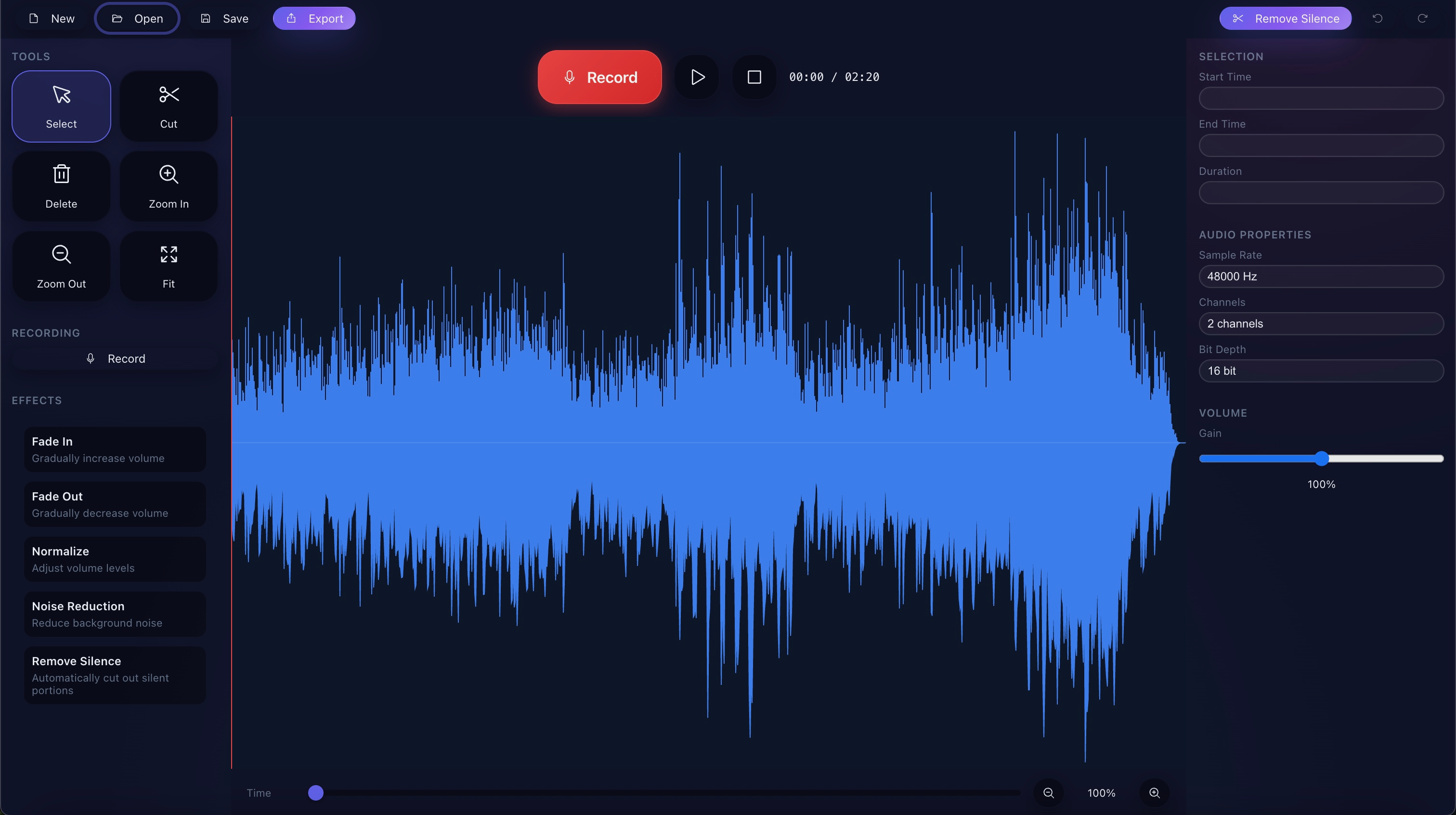
Screenshot: Voice Editor
Voice Editor waveform and silence removal tools.

Key features

  • Record & Open: Import an existing audio file or record directly with your microphone.
  • Waveform editing: Click and drag on the waveform to select sections. You can play, pause, and preview selections.
  • Remove Silence: Automatically trim long pauses from your voiceovers to make the pacing tighter without manual cutting.
  • Volume: Increase or decrease the gain if your recording is too quiet.
  • Export: Save your polished audio to drop into the Advanced Editor or Video Creator.

7) History & recovery

⚡ Quick steps
  1. On the homepage hub, click History to see your past exports and recover recent work.
  2. Click any entry to play it, or click Show in Folder to find it on disk.
  3. Click Clear All to remove entries from the list (your actual files are not deleted).
  4. For reusable prompts, assets, flows, RSS feeds, and narrators, use Library.

Previous projects

The History section is for outputs, recent project state, and recovery. It is different from Library, which stores reusable building blocks for future work.

  • List of outputs: Tracks your recent exports so you can revisit results.
  • Open/Reveal (Pro): Play a past output directly or open its folder via Show in Folder.
  • Clear All: Removes entries from the list. This does not delete files on disk.

Tip: The Home hub also shows recent projects so you can jump back into what you were working on quickly.

Script history (Pro)

  • Saved Scripts: Searchable list of Script Shufflr sessions.
  • Rename titles for organization, Delete individual entries, or Clear All.
  • Add New: Create a blank script. It opens in the editor immediately so you can start writing.
  • View/Edit: Each row includes quick actions to preview the script (Markdown supported) or edit the text.
  • Copy script: Copy the current script to your clipboard for use elsewhere.
  • Default naming: New items start as Default Script #N. Click the title to rename.

Storage locations

  • Exports: Written to your configured save location.
  • Temporary clips: Created during trimming/merge and cleaned up after export; ensure adequate free disk space.
  • Settings & history: Stored locally by the app; clearing history affects in‑app lists only.

Housekeeping tips

  • Periodically move exports to project folders and archive raw inputs externally to keep your workspace light.
  • If you run low on disk space, reduce total duration or batch size, or process in smaller pages.

Autosave recovery (Platinum)

  • Work‑in‑progress edit plans and Create with AI drafts restore automatically on reopen.
  • Focus Sidebar history: Idea Browser Focus adds cleared items to a rolling history (up to 1,000). See Idea Browser for details.

10) Projects

⚡ Quick steps
  1. On the homepage hub, click Create Project or Video Shufflr .
  2. Click Video Shufflr to start a blank editing project in the Video Shufflr.
  3. Click Advanced Editor to start a blank editing project in the Advanced Editor.
  4. Click Create Project to start a blank editing project in the Video Creator.
  5. Click Create with AI to let the AI build a draft plan (Platinum).
  6. To reopen a past project, find it in the grid and click it.
  7. To share a project, use File → Save Project to export a .json file.

What it is

Projects is your library for creating new projects, reopening old ones, and staying organized across the app.

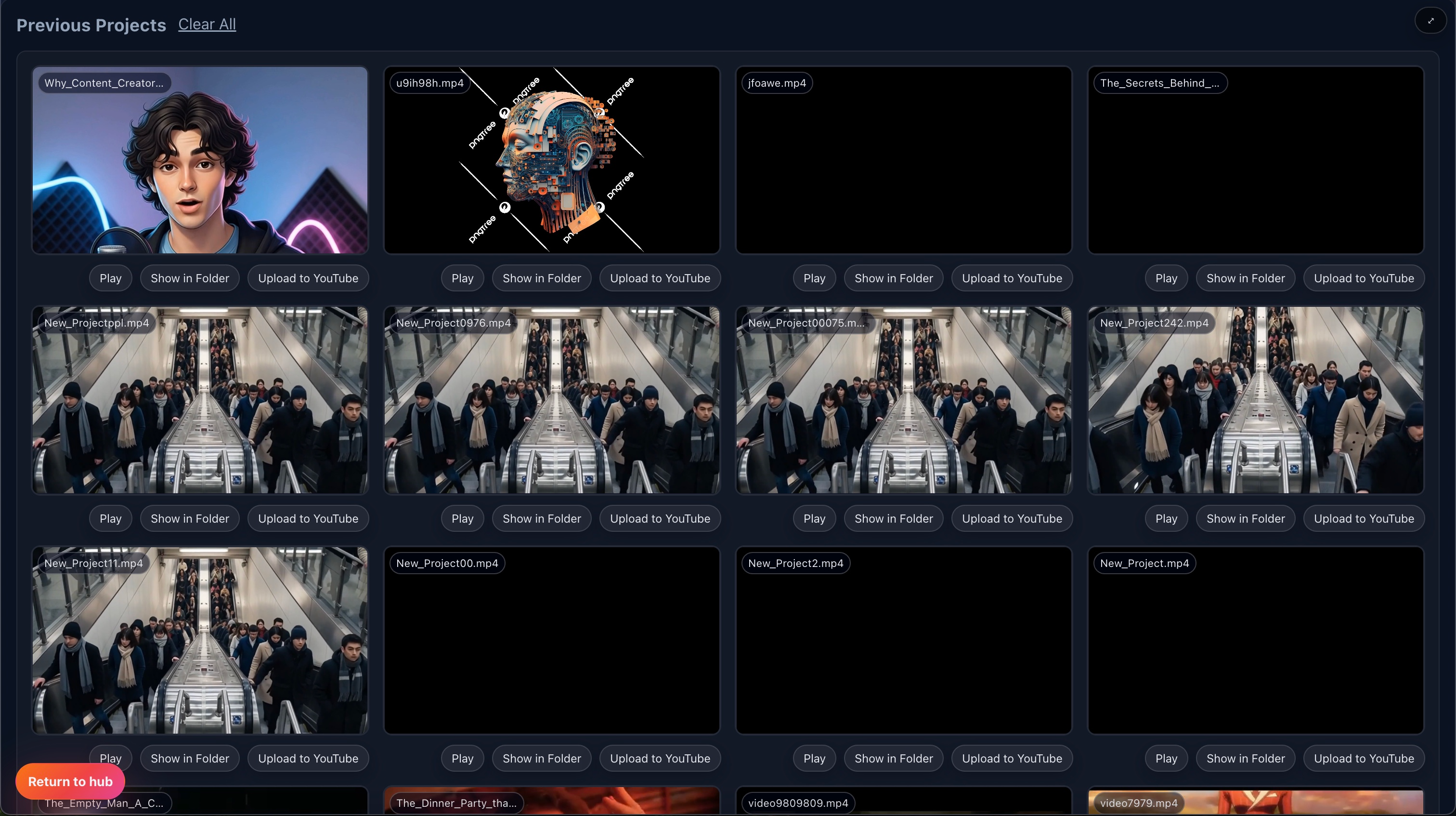
Screenshot: Projects Hub
The Projects grid showing recent edits and the Create buttons.

Key actions

  • Create Project: Start a fresh, manual editing project.
  • Create with AI: Let AI assemble the first draft plan for you.
  • Open Project: Import a shared JSON project file from someone else.
  • Grid view: Browse your library of existing projects and click to reopen and continue where you left off.

21) Video Downloader

⚡ Quick steps
  1. On the homepage hub, click More Tools → Video Downloader (Platinum / Diamond).
  2. Paste a video URL into the input field, or switch to Search mode to find videos.
  3. Toggle Audio only if you only need the sound.
  4. Choose your save folder, then click Download.

Video: Fastest media sourcing workflow

Watch on YouTube: Open on YouTube

What it is

Video Downloader helps you save videos or audio-only files to your computer for research and editing workflows. It supports a wide range of platforms, ensuring you can grab the content you need from almost anywhere on the web.

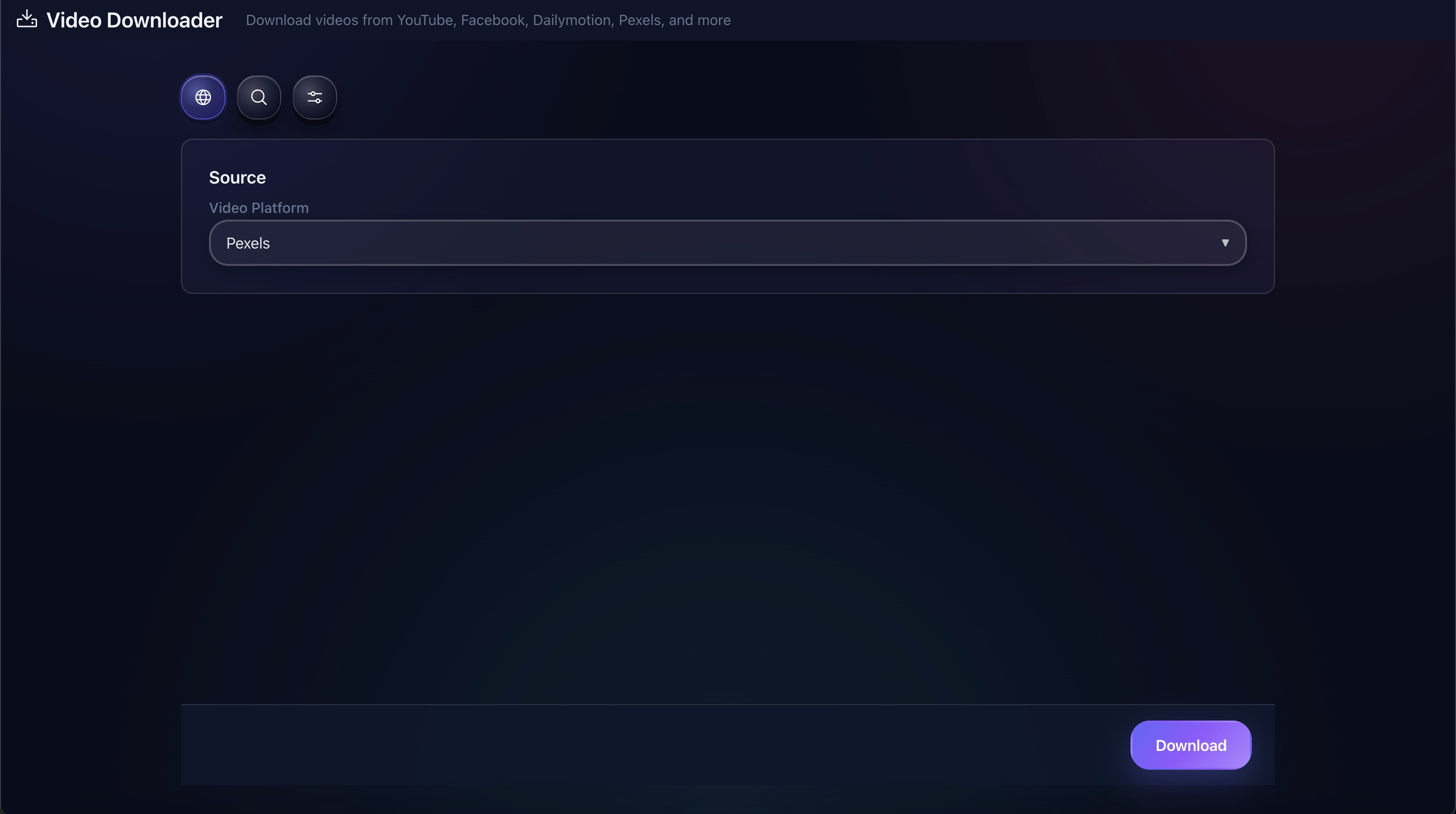
Screenshot: Video Downloader
Video Downloader interface with platform selection and download options.

Supported Sources

The Video Downloader supports a comprehensive list of platforms for Platinum and Diamond members:

  • Mainstream: YouTube, Facebook, Instagram, TikTok, X (Twitter)
  • Video Sites: Vimeo, Dailymotion, Bilibili
  • Streaming & Social: Twitch, Reddit, Snapchat, LinkedIn
  • Resources: Pexels (Stock), Yarn.co (Movie clips)

How it works

  • Modes: Switch between URL mode (paste direct links) or Search mode (find videos inside the tool).
  • Batch options: In URL mode, paste multiple URLs to download a queue of videos at once.
  • Audio-only: Check the "Audio-only" toggle if you only need the sound, which saves space and speeds up downloads. This is perfect for podcasting or sound design.
  • Save Location: Pick where the files go before downloading. You can use a custom path or your default project folder.

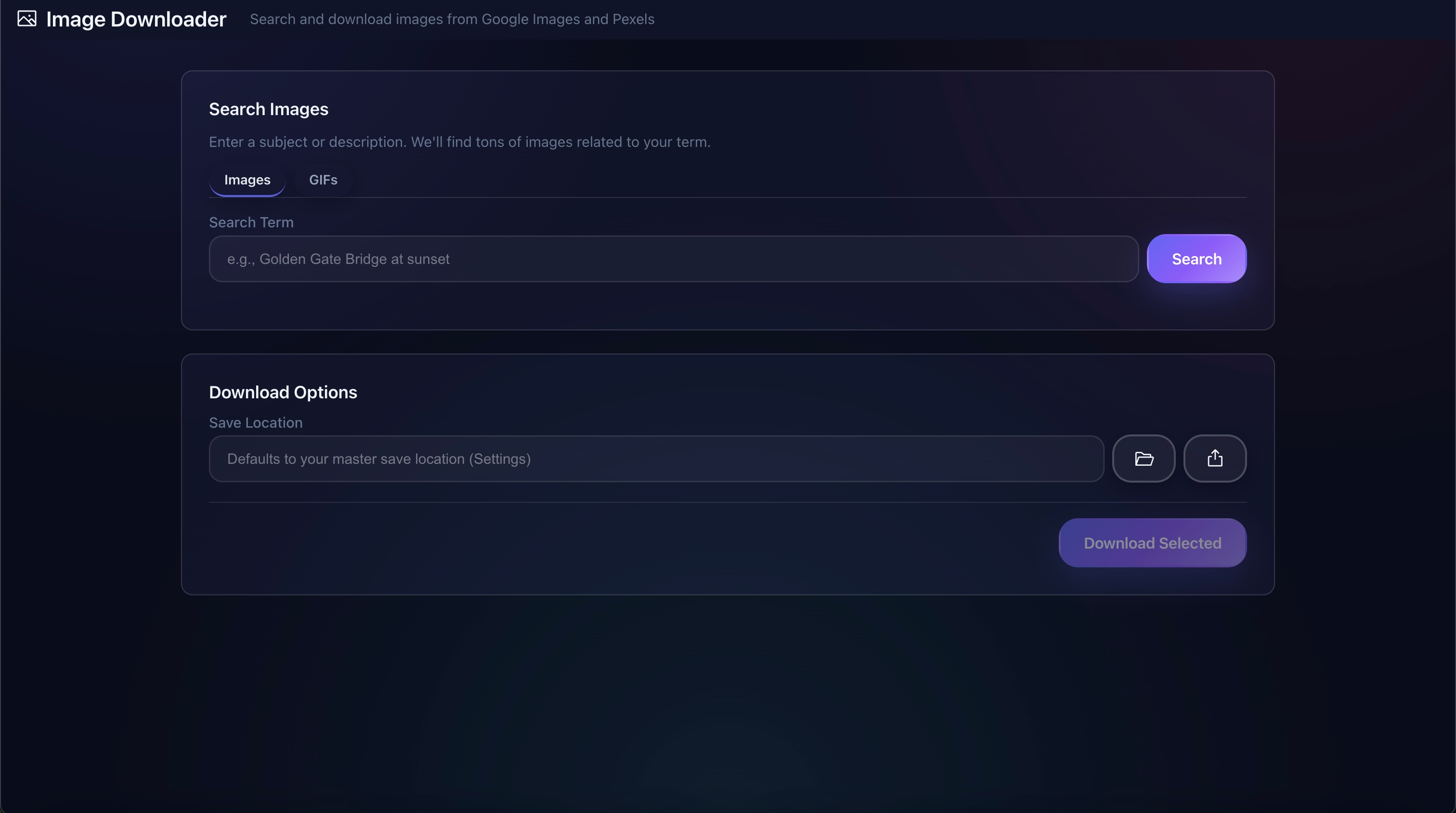
22) Image Downloader

⚡ Quick steps
  1. On the homepage hub, click More Tools → Image Downloader (Platinum / Diamond).
  2. Choose Images or GIFs from the format toggle.
  3. Type a descriptive search term (e.g., "mountain sunset wide shot").
  4. Click images in the results to select the ones you want.
  5. Click Download Selected to save them as a batch.

Video: Image sourcing workflow

Watch on YouTube: Open on YouTube

What it is

Image Downloader helps you find and download high-quality images and GIFs quickly to use in your thumbnails, projects, and marketing materials.

Screenshot: Image Downloader
Image Downloader search results and batch selection.

Supported Sources

The Image Downloader scans several top-tier sources to find the best match for your terms:

  • General Images: Google Images (Global search)
  • Stock Photos: Pexels (High-resolution, royalty-free)
  • Animations: Giphy (Trending GIFs and reactions)

How it works

  1. Pick your format: Choose between static Images or animated GIFs.
  2. Search smart: Type a specific search term, like "golden retriever close-up studio lighting".
  3. Select your favorites: Scroll the results and click to select the ones you want. You can select multiple images at once.
  4. Batch Download: Click Download Selected to save them all to your designated save folder.

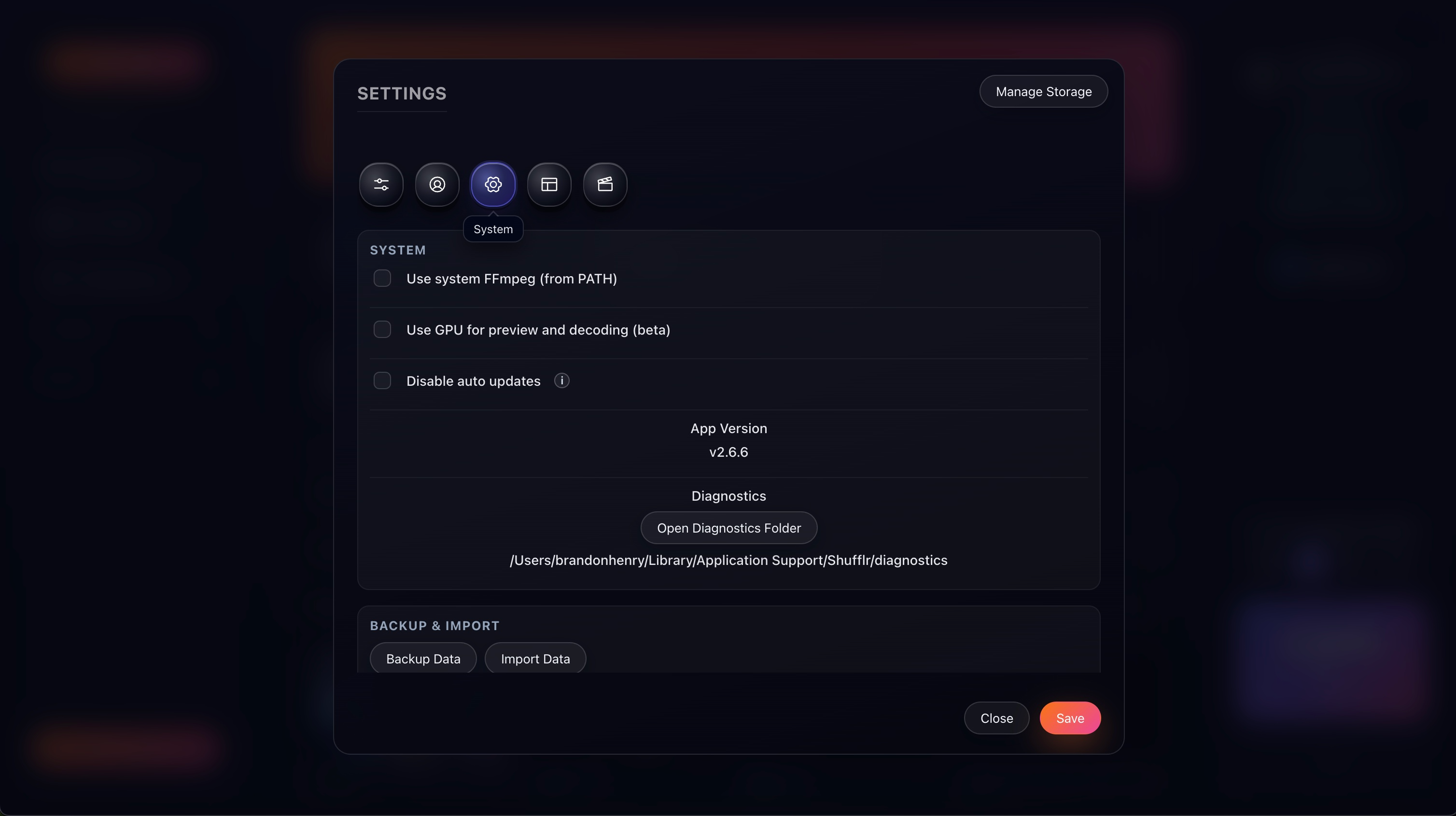
6) Settings

Where to find Settings: Open the Home hub and click the Settings button (gear) in the sidebar.

Screenshot: Settings & Export Data
⚡ Quick steps
  1. On the homepage hub, click the settings button with gear icon in the left sidebar to open Settings.
  2. Use Homepage Hub Layout to show or hide tiles/tools and drag them into the order you want.
  3. Enter your subscription email to activate Pro / Platinum / Diamond.
  4. Set your preferred Save Location for exported videos.
  5. Adjust Min/Max clip length and Total duration to match your style.
  6. Settings save automatically — just close the panel when done.

General

  • Dark mode: Toggle dark theme.
  • Save location: Choose the folder where exported videos are written. Use Open Save Location in the main UI to jump there.

Homepage Hub layout

  • Show/hide hub items: In Homepage Hub Layout, click the eye icon next to any tile or More Tools item to hide it from the homepage hub or show it again later.
  • Reorder your hub: Drag tiles and More Tools items up or down to put your most-used features first.
  • Bulk controls: Use Show all or Hide all to quickly reset or simplify the homepage hub.
  • Section toggles: You can also toggle the Flowboard button and Projects section on or off.
  • Saved automatically: Your homepage hub layout stays the way you set it, so the app opens with your preferred setup next time.

Video length

  • Min clip length: Lower bound for random segment duration.
  • Max clip length: Upper bound for random segment duration.
  • Total duration: Target length of the final merged video. Accepts seconds or MM:SS format.

Video

  • Remove audio: Export without source audio.
  • Auto‑detect jump cuts: Use cut detection for smarter segment boundaries (Pro recommended).
  • Review before merge (Pro): Enables the planning UI to preview/refresh segments before export.

Subscription

  • Subscription email: Enter the email used at checkout to unlock Pro. The header updates when active.
  • Manage/Unsubscribe: Links are in the header when Pro is active.

Data import/export

  • Export Data: Create a backup of your scripts, saved channels, saved video ideas, and prompt library to a single file.
  • Import Data: Restore from a previously exported file. Useful when moving to a new machine or sharing presets across installs.
  • Status indicator: A small inline status shows progress/success during import and export operations.

Script Shufflr

  • Script Shufflr: Turn on to generate text for scripts.
  • Show Script Shufflr (Pro): Toggle to display/hide the Script Shufflr card in the main UI.

Audio / TTS

  • Text‑to‑Speech: Enables voiceover generation from text. Fetch voices and generate VoiceOver in‑app.
  • Fetch voices: Pulls your available voices after adding a valid key.
  • Voice selection: Choose the desired voice before generating.

Pro features

  • Smooth clip transitions: Adds basic transition smoothing.
  • High‑quality encoding: Prefers quality over speed for the final export.
  • Smart shuffle ordering: Experimental ordering to improve perceived flow.

System

  • Use system FFmpeg (from PATH) (optional/advanced): Fractal includes its own processing engine by default. Only enable this if you specifically want to use a system-installed FFmpeg.
  • App version: The footer or header may display the current version for reference when reporting issues.

Settings persist across sessions. Quick settings in the main UI mirror key options for faster iteration, while the Settings panel offers the complete list, including Homepage Hub customization.

Autosave (Pro+)

  • Status: Always on for Create with AI drafts, Advanced Editor plans, and Thumbnail Space.
  • Storage: Autosaved data is stored locally and restored on reopen.

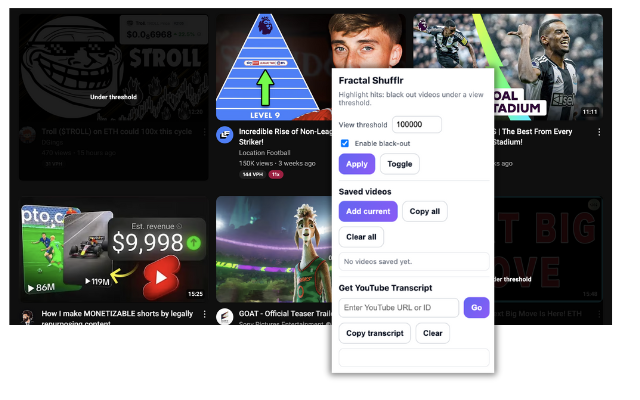
8) Chrome extension: Fractal Shufflr for YouTube

⚡ Quick steps
  1. Install Fractal Shufflr for YouTube from the Chrome Web Store.
  2. Pin the extension to your Chrome toolbar so it's easy to access.
  3. Go to YouTube and click the extension icon in your toolbar.
  4. Set a view threshold (e.g., 30,000) and click Apply.
  5. Videos below your threshold will be blacked out — only hits stay visible.

What it does

The extension highlights high‑performing content by masking (black‑ing out) videos under a view threshold. It works across YouTube Home, Search, Channel pages, and Related lists so you can focus on potential hits faster.

Screenshot: Chrome Extension

Installation

  1. Open the Chrome Web Store listing: Fractal Shufflr YouTube Extension.
  2. Click Add to Chrome and confirm.
  3. Pin the extension from the puzzle icon so it’s easy to access.

Advanced: If you prefer manual install for development, you can still use chrome://extensionsDeveloper modeLoad unpacked with the videoshuffle/extension folder.

Using the popup

  • View threshold: Set the minimum views a video must have to remain visible (default: 30,000).
  • Enable black‑out: Toggle masking on/off.
  • Apply: Saves settings and applies them to the active YouTube tab.
  • Toggle: Quickly flip the enabled state without changing the threshold.
  • Status: Shows whether masking is active or if you need to open a YouTube tab.

Saved videos

  • Add current: Add the current video URL to a saved list for later reference.
  • Copy all: Copy the saved list to the clipboard.
  • Clear all: Empty the saved list.
  • Sync storage: Settings and saved videos are stored in Chrome sync storage and persist across sessions (limited to recent items).

Permissions & privacy

  • Host permissions: https://www.youtube.com/*, https://youtu.be/*, and https://videoshufflr.com/* for content analysis and integration.
  • Storage: Used for saving your threshold, enabled state, and saved videos list.
  • Clipboard write: Used when you click Copy all for saved videos.

Known limitations

  • Layout changes by YouTube can temporarily affect masking. Use Apply to re‑run or refresh the page.
  • Regional/language variants may change how views are displayed and detected.
  • Only tabs matching YouTube URLs are affected.

Use the extension alongside Niche Finder to quickly curate candidates, then bring the best clips or ideas into Fractal for editing.

15) YouTube integration

⚡ Quick steps
  1. Open the My Channels section in the app.
  2. Add your YouTube channel to the My Channels list.
  3. Click Connect to link your YouTube account (optional).
  4. Complete the sign-in flow in the browser that opens.
  5. Return to the app — your channel data loads automatically.
  6. Sign out from the same Connect area if you need to switch accounts.
  7. Add any number of personal accounts for tracking.
  8. Add any number of competitor accounts for tracking.

Video: YouTube account connection walkthrough

Watch on YouTube: Open on YouTube

What it does

When enabled for your account, YouTube integration lets Fractal connect to YouTube for channel context (your channel / competitors), analytics sync, and smoother YouTube-powered workflows inside the app.

Where to find it

  • My Channels: Follow channels and power channel/idea workflows (Platinum+).
  • Connect button: Use the Connect button to link your YouTube account.
  • Channel Dashboard Analytics: Uses this connection layer to load private YouTube Analytics data after the account is linked.

Connect your account

  1. Click Connect in the YouTube section.
  2. Complete the device sign‑in flow in the browser.
  3. Return to the app; your channel and analytics will load when connected.

Common “YouTube in the editor” workflows

  • Following channels: Track competitors and jump back to them quickly from My Channels.
  • Analytics loading: Use the same connected account so Fractal can fetch channel dashboard analytics and per-video metrics for your personal channels.
  • Idea workflows: Use channel context + research tools to move from “what’s working” → “what to make next”.
  • Downloader/login: If a YouTube download flow asks you to sign in, follow the in-app prompt and retry.

Sign out

If you connect an account, you can sign out from the same area you connected it (typically under My Channels or the relevant prompt).

Troubleshooting

  • Wrong Google account: If sign-in succeeds but you don’t see expected data, sign out and reconnect with the intended account.
  • Quota / temporary failures: Retry later. Some YouTube-backed requests can fail temporarily.

14) Niche Finder (Pro)

⚡ Quick steps
  1. On the homepage hub, click More Tools → Niche Finder.
  2. Use the Niche Finder hub, click Niche Tool Card to use different tools to find topics and niches.
  3. In the Topics tab, type a niche or topic and search.
  4. Switch to Idea Browser to see YouTube videos performing in that niche.
  5. Open the Focus Sidebar to see top videos ranked by views.
  6. Click Add to Thumbnail Space on any video you want to save for later.

Video: Fractal Niche Finder tutorial

Watch on YouTube: Open on YouTube
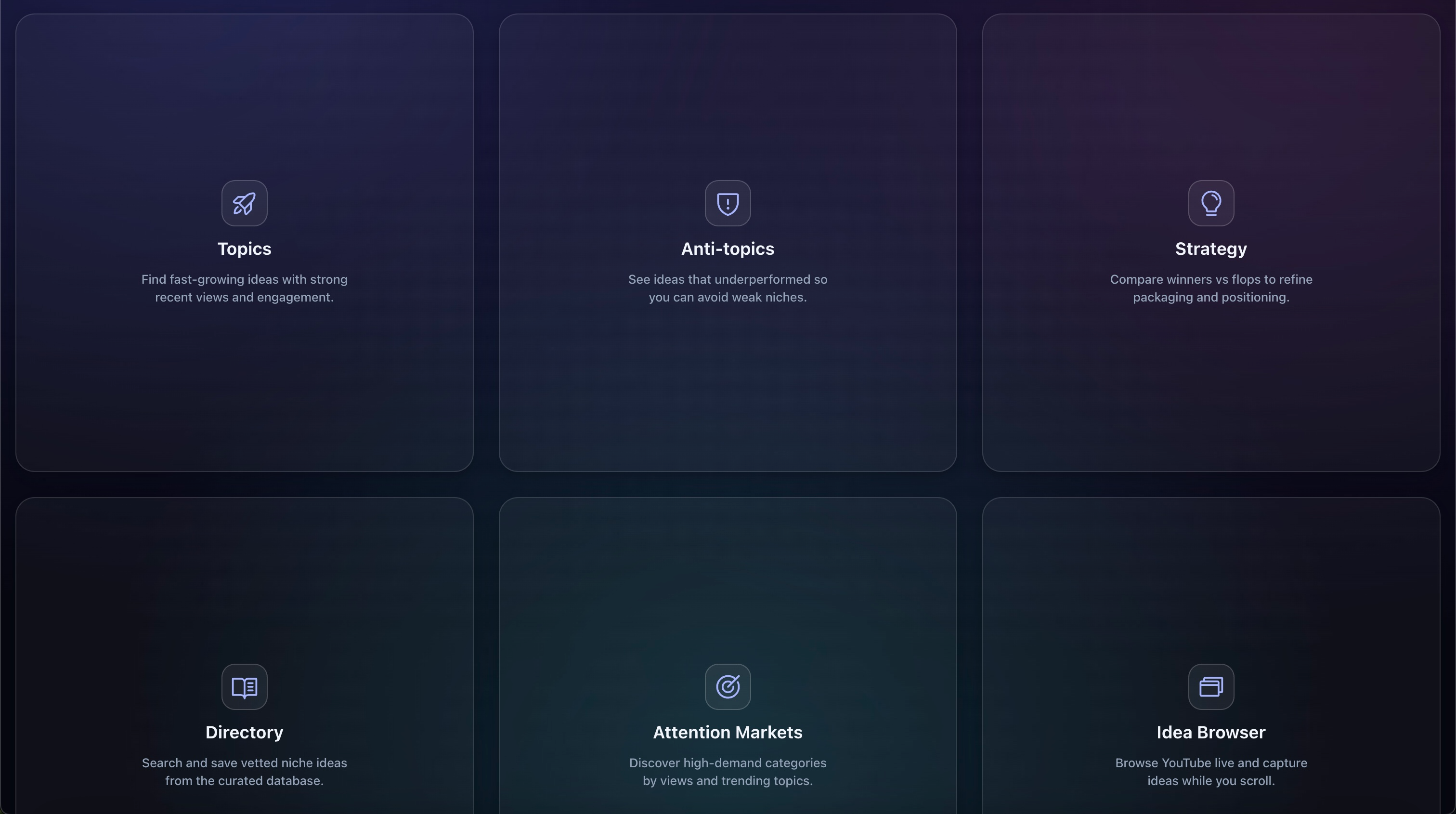
Screenshots: Niche Finder & Idea Browser

Opening Niche Finder

Open the Home hub, then use More toolsNiche Finder (or the sidebar navigation if available in your build).

Tabs (current)

  • Topics: Discover niches and formats based on query inputs.
  • Anti‑topics: Avoid low‑signal or saturated areas.
  • Strategy: High‑level positioning and direction ideas.
  • Directory: Browse a curated list of niches.
  • Attention Markets: Surface high‑demand clusters by views and velocity.
  • Idea Browser: Open a YouTube view for deeper inspection and Focus Sidebar analysis.
  • Similar Channels (Platinum): Find channels related to a strong seed.
  • Thumbnail Gallery: Visual grid for pattern‑spotting across thumbnails.
  • Thumbnail Space: Save candidates for later review and iteration (Platinum).

Filters & pagination

  • Filters vary by tab; expect category, include‑shorts, and range sliders where relevant.
  • Thumbnail Gallery: Use Load more thumbnails to append results without losing your place.
  • Idea Browser: Sort and filter via the Focus Sidebar (views, likes, comments, date, subs, VPS).

Workflow tips

  • Start in Topics or Attention Markets to identify high‑signal areas, then drill into Idea Browser for detail.
  • Use Thumbnail Gallery to spot visual patterns fast, then save winners to Thumbnail Space (Platinum).

Similar Channel Finder (Platinum)

Quickly discover channels similar to a high‑performing video or channel you’re studying. Use it to expand research, find competitors, and uncover repeatable formats across your niche.

  1. Open Idea Browser and use the Focus Sidebar to select a high‑view video.
  2. Click Find Similar Channels in the Focus Sidebar.
  3. The app opens the Similar Channels tab and begins fetching results (usually within 1–5 minutes).
  4. Click any result to open that channel inside Idea Browser; skim its top videos in the Focus Sidebar.
  5. Repeat Find Similar Channels on any promising result to go deeper and map the niche.
  • Export: Use Export Similar Channels to copy a CSV report to your clipboard.
  • Tips: Start from genuinely high‑signal videos. Adjust your Focus Sidebar filters (e.g., include shorts) to broaden or narrow scope.

Prerequisites

  • Platinum plan active in the app.
  • Idea Browser available (or use the Similar Channels tab inside Niche Finder).

Two ways to start

  • From Idea Browser: In the Focus Sidebar on any high‑view video, click Find Similar Channels.
  • From Niche Finder: Open the Similar Channels tab, paste a channel @handle or URL, then click Find Similar.

Controls & sorting

  • Sort: Toggle by Similarity, Subscribers, or Total views (asc/desc) to prioritize what matters.
  • Open channel: Click a result to load the channel in Idea Browser and scan its top videos.
  • Load more: Reveal additional candidates and keep exploring laterally.
  • Export PDF: Package your findings for sharing or later review.

Why use it

  • Map the niche: Uncover adjacent creators and sub‑genres from any proven seed.
  • Find competitors: See who wins on similar topics, formats, and pacing.
  • Clone repeatable formats: Identify hooks and structures that consistently perform.
  • Prospect collabs/ads: Build a targeted list of channels with audience fit.

Troubleshooting

  • Platinum only: If you see “Platinum only,” confirm your plan status in Settings.
  • No results: Start from a genuinely high‑signal channel or video; try a different seed.
  • Slow fetch: Typical runs complete in 1–5 minutes; stay on the tab until results load.

13) Script Shufflr (Pro)

⚡ Quick steps
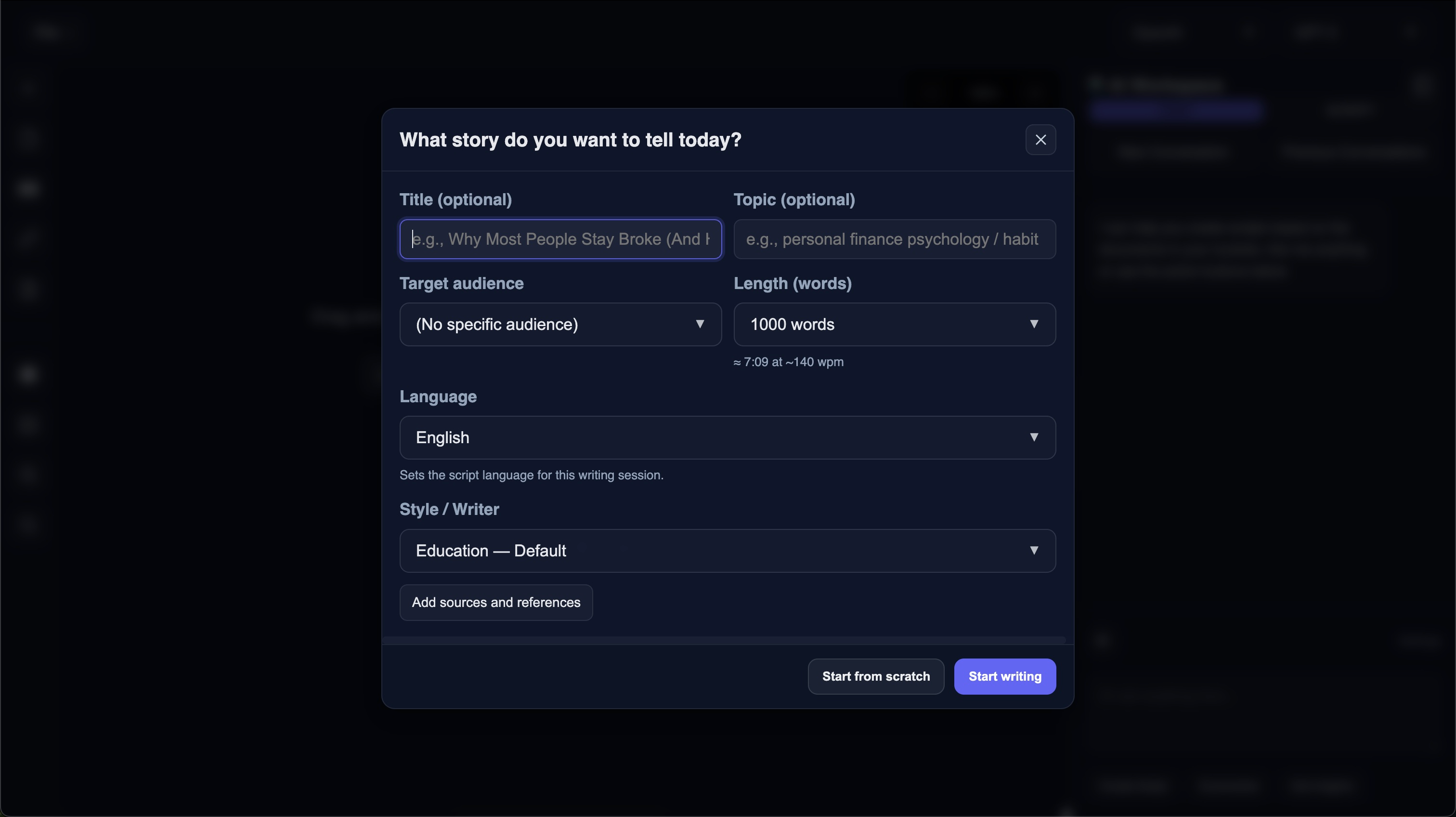
  1. On the homepage hub, click Script Shufflr.
  2. Enter the basic details about what script you want to automatically write, or skip to start from scratch.
  3. Click Generate Script to generate a brand new script right in chat.
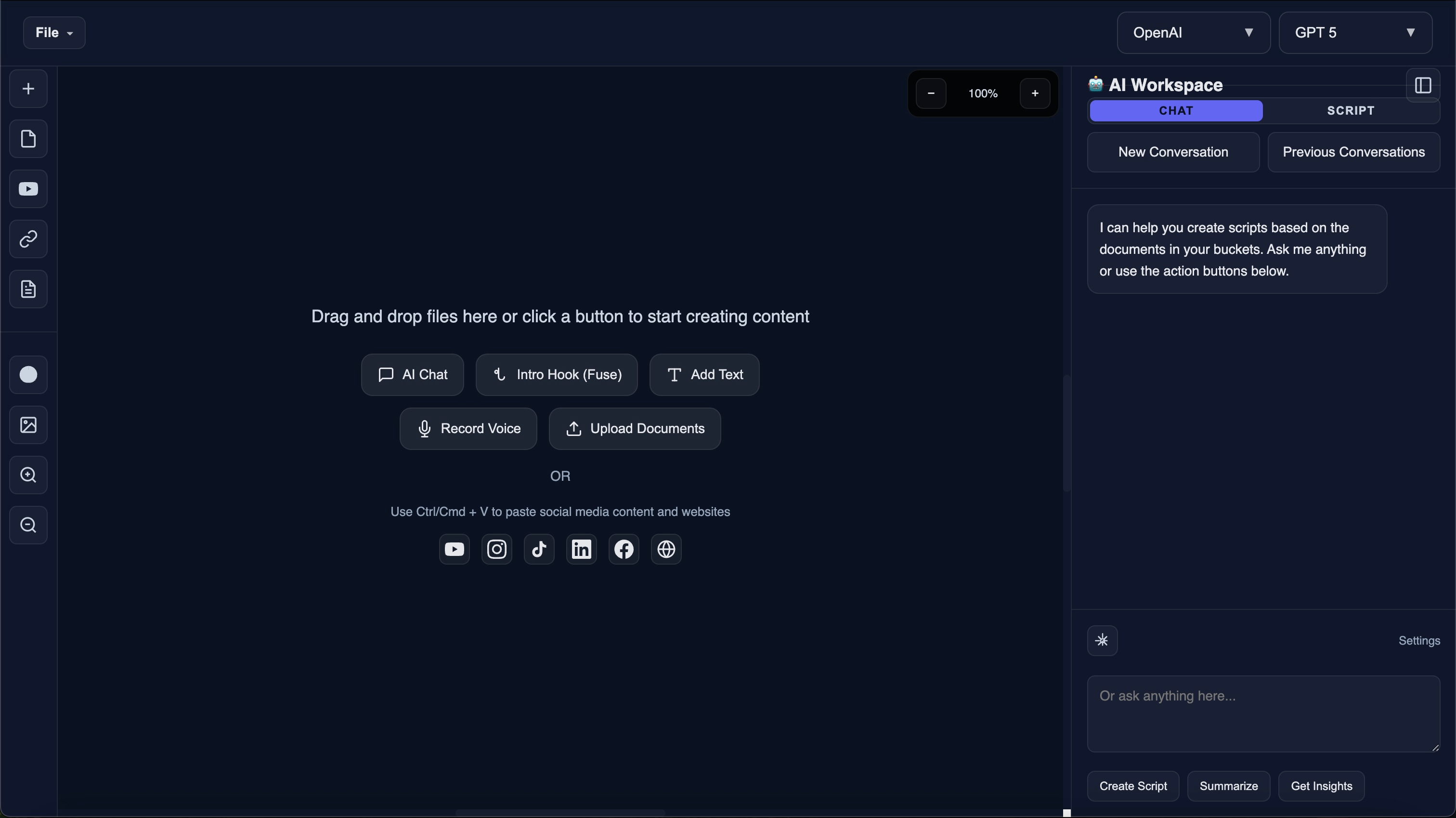
  4. Click Script tab to view only the script or edit specific sections.
  5. Click File in the top left and save the script or generate a voiceover.

What it is

Script Shufflr helps you rewrite or iterate on scripts with a multi‑pass AI flow that preserves context within a single thread. It’s ideal for narration, hooks, and tightening copy to match high‑tempo edits.

Screenshot: Script Shufflr

Prerequisites

  • Pro subscription active in the app.
  • Script Shufflr enabled in Settings.

Starting a session

  1. Open the Home hub and click the Script Shufflr tile (or select it from the sidebar under AI design).
  2. Paste your script into the input area.
  3. Click Shuffl Script to create a new thread for this topic.
  4. Review the response in the transcript pane.
  5. Click Continue to ask the assistant to iterate again while keeping context in the same thread.
  6. Use Reset when switching topics to clear the session and start fresh.

Note: The transcript is assistant‑only for readability. Your original input is not duplicated in the transcript pane.

Script history

  • Saved Scripts card: View a searchable list of past sessions.
  • Search: Filter by title or text snippets to find a previous idea quickly.
  • Rename: Click a title to rename for better organization.
  • Add New: Create a blank script (starts as Default Script #N) and jump straight into editing.
  • View/Edit: Use row actions to preview in a clean Markdown view or open the editor to modify the body.
  • Copy script: Quickly copy the full script to your clipboard.
  • Delete: Remove individual entries you no longer need.
  • Clear All: Purge the entire script history.

Tips for better outputs

  • Short, specific prompts: Describe the audience, tone, and constraints (e.g., "60–90 seconds, punchy hook, 3 beats").
  • Iterate with Continue: Ask for variants (more concise, more energy, add CTA, tailor to niche) to quickly get multiple cuts.
  • Chunk long scripts: For multi‑minute narration, process in pages with brief summaries to maintain coherence.
  • Align to visuals: Mention pacing and scene types if you already know your B‑roll plan.

Create Voiceover from script

Generate a narrated voiceover directly from a saved script.

  • Where: In Saved Scripts, click View on a script, then choose Create Voiceover.
  • Choose voice & save location: Pick a voice/provider and where to save the audio file.
  • Playback: Play generated voiceovers back in‑app and use them in the Audio card.

Video: 1‑click Script + Voiceover tutorial

Watch on YouTube: Open on YouTube

Delete confirmation

When deleting a script, an extra confirmation prevents accidental removals.

Troubleshooting

  • Pro required: If gated, ensure your subscription is active and the app shows Pro active in the header.
  • Generation unavailable: Ensure you’re on Pro and try again later if services are busy.
  • Rate limits or network issues: Wait and retry; large/rapid requests may trigger limits.
  • Continue unavailable: If you updated recently, restart the app to ensure all controls are active.

Use Script Shufflr early to shape the narrative, then finalize with Pages and Review‑before‑merge for a well‑paced, on‑brand edit.

26) My Channels (Platinum)

⚡ Quick steps
  1. On the homepage hub, click My Channels (Platinum).
  2. Type a YouTube channel handle (like @channelname) and press Enter.
  3. Click Save to add it to your saved list for quick access.
  4. Click any saved channel to open it in Idea Browser instantly.
  5. Use the delete button to remove channels you no longer need.

Video: My Channels setup walkthrough

Watch on YouTube: Open on YouTube

What it is

My Channels is Fractal's channel-management hub. Follow competitors and favorite creators, then jump back to any of them in one click — no re-typing handles.

How to open it

  • From the Home hub, click the My Channels tile.
  • Or open Niche FinderIdea Browser tab and use the saved-channels panel on the left.

Key features

  • Channel Save: Save unlimited YouTube channel handles (with or without @). Your saved list appears for one‑click access.
  • Open fast: Click a saved channel to jump directly into its page inside Idea Browser.
  • Analytics dashboard: For connected personal channels, Fractal can show range-based channel totals, all-channel rollups, and per-video analytics in the same workflow.
  • Manage: Remove any saved channel when you no longer need it.
  • Recent search history: Recently searched channels are remembered; use Clear Recent Channel Search History to wipe suggestions.

Analytics in My Channels

My Channels is also the launch point for Fractal's synced analytics dashboard. After you connect YouTube, you can review account-level totals, aggregate all-channel performance, recent-video analytics, and range-based summaries without leaving the channel workflow.

Supported range views

  • 7d: Quick pulse check for recent uploads and short-term swings.
  • 28d: Default operating view for monthly performance.
  • 90d: Better for spotting trends that are larger than a single upload cycle.
  • 365d: Long-view performance and seasonality comparisons.

Go to any channel

Type a channel handle (with or without @), paste a YouTube link, or type a keyword and press Enter. We remember your last searches so you can jump back with one click.

Settings

Click Features to tweak a few friendly options:

  • Blackout number: Move it up or down to change what counts as "good enough."
  • Focus Sidebar: Choose how often it updates, set the minimum views it should show, and make it bigger if you want a large reading view.

26A) Channel Dashboard Analytics (Platinum)

⚡ Quick steps
  1. Connect YouTube from the app so Fractal can access private analytics data for your personal channels.
  2. Open My Channels and select one of your connected channels.
  3. Switch between 7d, 28d, 90d, and 365d ranges.
  4. Review account totals, all-channel totals, and per-video analytics for recent uploads.
  5. Sign into the website Members Area with the same email to view the synced dashboard on the fly.

Video: Analytics connection walkthrough

Watch on YouTube: Open on YouTube

What it is

Channel Dashboard Analytics is Fractal's synced analytics layer for your personal YouTube channels. It combines private YouTube Analytics data, calculated rates, and range-based rollups so you can move beyond public lifetime stats when checking performance.

How it fits with YouTube integration

YouTube integration is the connection and auth layer. Channel Dashboard Analytics is the reporting layer that appears after the right account is connected. Connect first, then use My Channels and the Members Area to view the synced analytics.

Where to view it

  • Desktop app: In My Channels, where you can switch between channels, see overview totals, and inspect recent video analytics.
  • Website Members Area: In the synced dashboard at /members, using the same email as the desktop app and billing.

Supported date ranges

  • 7d: Last 7 days
  • 28d: Last 28 days
  • 90d: Last 90 days
  • 365d: Last 365 days

Supported analytics metrics

  • Base metrics: Impressions, CTR, Views, Engaged Views, Watch Time, Avg View Duration, Avg % Viewed, Likes, Comments, Dislikes, Shares, Subs Gained, Subs Lost, Playlist Adds, Playlist Removes.
  • Derived metrics: Engaged View Rate, Net Subs, Subscriber Conversion, Engagement Actions, Engagement Rate, Like Rate, Comment Rate, Share Rate, Dislike Rate, Playlist Net Adds, Playlist Add Rate.

Scope of the dashboard

  • Account-level totals: View the analytics summary for one selected channel.
  • Aggregate all-channel totals: Combine analytics across your connected accounts for a portfolio-level read.
  • Per-video analytics: Review the same supported analytics for recent uploads, not just for the whole channel.

Members Area sync

The website dashboard mirrors the same synced analytics so you can check stats on the fly. It uses the same email as the app and billing, supports range switching, shows recent videos, and depends on the desktop app syncing your latest channel data.

  • Overview tab: Start with all connected accounts, then drill down into one channel.
  • Recent Videos tab: See public lifetime stats plus range-based analytics on synced uploads.
  • Same-email requirement: Use the same email in the desktop app and website members area so the synced dashboard can load your data.

Impressions and CTR caveat

Impressions and CTR depend on YouTube Reporting API reach files. Those files can appear later than the rest of your analytics, so reach metrics may lag even when views, watch time, and engagement metrics are already showing.

Troubleshooting

  • Not connected: Reconnect YouTube if Fractal says analytics cannot load for the channel.
  • Unsupported query: Some YouTube Analytics report combinations may not be available yet; Fractal will surface that state instead of inventing a number.
  • Analytics unavailable for this range: Retry later if YouTube returns a temporary error or is still provisioning data.
  • Members Area looks empty: Open the desktop app with the same email signed in and let it sync fresh channel data first.

27) Idea Browser (Platinum)

⚡ Quick steps
  1. Open Niche Finder → Idea Browser tab (or go via My Channels).
  2. Type a search term or channel name and browse the results.
  3. Turn on Blackout and set a view threshold to hide low-performing videos.
  4. Check the Focus Sidebar on the right — top videos ranked by views.
  5. Click Copy Link or Copy Transcript to grab content for research.

Video: Idea Browser workflow

Watch on YouTube: Open on YouTube

What it is

Idea Browser is Fractal's research-inside-the-app workflow. It helps you browse ideas quickly and use a Focus Sidebar to surface strong videos, with optional blackout/masking for low-view tiles.

Key features

  • Hide low‑view videos: Turn on Blackout and set a number (like 100,000). Videos under that threshold dim, so strong ideas stand out.
  • Watch the Focus Sidebar: A list on the right shows the best videos on the page — title, views, how new it is — and quick action buttons.
  • One‑click actions: Copy the video link, copy the transcript (when available), or Add to Thumbnail Space (Platinum) to save it for later.

Focus Sidebar sorting & filters

The Focus Sidebar enriches each video with additional stats and lets you sort by what matters.

  • Search: Filter the list by matching title or channel text.
  • Sort by: Choose Views, Likes, Comments, Date (newest), Subs (channel subscribers), or Views/Subs (VPS).
  • Direction: Toggle ascending/descending with the arrow button.
  • Include Shorts: Off by default; enable to include YouTube Shorts in the list.
  • Min views: Set a minimum in Features to hide low‑signal items by default.

Focus Sidebar history

The Focus Sidebar keeps a rolling history so you don't lose good finds when the list clears.

  • Auto‑save on clear: Items are added to History whenever the Focus list clears (refresh, navigate, or explicit clear).
  • Capacity: Up to 1,000 videos stored; oldest entries drop off automatically.
  • Use: Revisit titles, re‑copy links or transcripts, and add missed items to your Thumbnail Space.

Simple workflows

  • Channel checkup: Type @channelName → turn on Blackout → the best ideas pop to the top. Use Focus to skim and copy a transcript for notes.
  • Keyword hunt: Type a topic → see which titles and thumbnails get real traction. Raise or lower your Blackout number to match your goals.
  • Thumbnail pick list: As you spot winners, click Add to Thumbnail Space. La

Focus Sidebar history

The Focus Sidebar keeps a rolling history so you don’t lose good finds when the list clears.

  • Auto‑save on clear: Anytime the Focus list clears (refresh, navigate, or explicit clear), those items are added to History.
  • Capacity: Up to 1,000 videos are stored at a time; oldest entries drop off automatically.
  • Use: Revisit titles, re‑copy links or transcripts, and add missed items to your Thumbnail Space.

9) Advanced Editor

⚡ Quick steps
  1. On the homepage hub, click Advanced Editor.
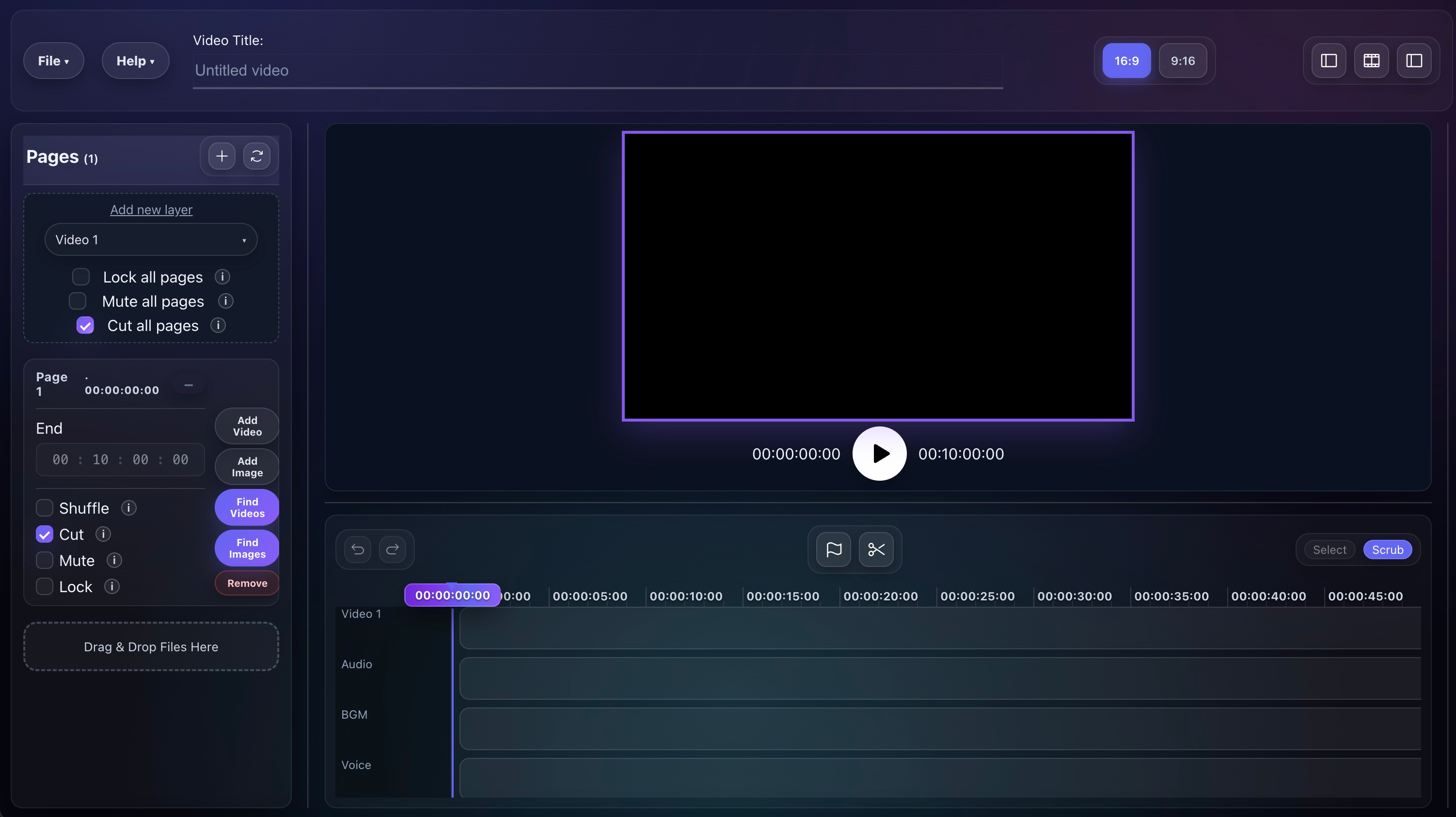
  2. Click + icon to create a section (e.g., Hook, Intro, Body1, Body2, Outro).
  3. Drop or select video files into each section.
  4. Repeat for additional sections (Body, Outro, etc.).
  5. Click Shuffle & Merge! to export your video in section order.

Video: Advanced Editor tutorial

Watch on YouTube: Open on YouTube. See also Features for quick cards on Find Images and Add Custom.
Screenshot: Advanced Editor

Where these tools live

  • Advanced Editor: Open from the Home hub (tile) under Video editing.
  • Video Creator (Platinum): Open from the Home hub (sidebar item and tile in many builds).
  • Flowboard (Platinum): Open from the Home hub (Flowboard button) to storyboard and plan.

Quick settings & sliders

Inside the editing workspace, use the compact controls to iterate fast without opening Settings:

  • Remove audio, Auto‑detect cuts, Review before merge, and Show Script Shufflr toggles.
  • Min/Max clip length and Total duration sliders.

YouTube links as sources: In the Advanced Editor, paste YouTube video URLs as inputs; Fractal will automatically download them for you.

Pages & ordered merge

Create multiple pages to structure your output (e.g., Hook → Body → Outro). Fractal shuffles within each section and preserves section order in the final export.

  1. Click Add Section to create a new section.
  2. Drop or select files into each section as desired.
  3. Optionally, assign per‑section end times to help hit your target duration precisely.
  4. Run Shuffle & Merge!. The final video respects your section order while keeping internal randomness.

Tip: Use the per‑section Add Image button to include stills (.jpg/.jpeg/.png/.webp) alongside videos; they are turned into short motion clips automatically.

  • Drag & drop: Move files between pages or reorder within a section for precise control.
  • Duplicate files: Create a duplicate of a video wherever it’s been added to test variants.

Tips:

  • Use a short Hook section with punchy clips and a longer Body section for the main content.
  • For long‑form, break into thematic pages to control pacing and topic shifts.

Find Images (Advanced Editor)

Quickly source relevant images without leaving the editor, then add them into any section. Stills are automatically turned into short motion clips so they feel natural in sequence.

  1. Open the Advanced Editor and locate a section where you want images.
  2. Click Find Images (purple). The Find Images window opens.
  3. Type a subject or description (e.g., Golden Gate Bridge at sunset) and click Search.
  4. Click thumbnails to select one or many results.
  5. Click Add to insert the selected images into the current section.
  • Clip behavior: Images are converted into motion clips and follow your Min/Max clip length and Total duration rules.
  • Audio: Images are silent. Add BGM and/or VO in the Audio section if desired.
  • Preview: Plans that include images may use a merged preview for accuracy.
  • Network: Requires an internet connection to fetch results.
  • Rights: Ensure you have permission to use downloaded images (licenses/fair use). When in doubt, replace with your own assets.

Add Custom (text video generator)

Create a short motion graphic clip with animated text over a solid, image, or video background—perfect for hooks, captions, and outros.

  1. In the Advanced Editor, click Add Custom (purple) inside any section.
  2. Choose a Background type: Solid, Image, or Video. Pick color or files as needed; for video, you can set a start time and optionally Remove audio.
  3. Enter your Text and style it: font, color, size, position grid, and animation (with duration).
  4. Adjust extras as needed: vignette strength, background motion (pan/shrink) and intensity/size, resolution, and clip length.
  5. Click Preview to see it live, then Create to render and automatically add the clip to your current section.
  • Use cases: Openers, CTAs, lower‑thirds, disclaimers, end cards.
  • Readability: Keep high contrast between text and background; use vignette or background blur/motion to separate text.
  • Audio: If you use a background video, consider muting it and layering BGM/VO in the Audio section.
  • Workflow: Create multiple short customs for multi‑slide sequences.

Review before merge (planned segments)

Preview a full set of planned segments before committing to export. Refresh weak segments without regenerating the whole plan.

  1. Enable Review before merge in Quick settings or Settings.
  2. Click Shuffle & Merge! to generate a plan instead of immediately exporting.
  3. Scroll through the planned clips to preview them.
  4. Click Refresh on any segment you don’t like to replace it with a new random pick.
  5. Optionally toggle Include/Exclude for specific clips to curate more tightly.
  6. When satisfied, click Export to render using the curated plan.
  • Timestamp replacement: Click a planned clip’s timestamp (e.g., 4.0s) to open a replacement popup. Preview the original, pick a new source file, and choose start/end times.
  • Reorder planned clips: Drag and drop planned clips to change their order before exporting.
  • Scrubber + transport: Use the scrubber and play/pause to navigate planned previews faster.
  • Deferred media load: Planned preview doesn’t auto‑load heavy media until needed to save resources.

Inspector script panel

Add and view a script in the right‑side Inspector while editing. Projects created via Create With AI automatically attach the generated script; you can also add/edit a script manually for any project.

Behind the scenes, Fractal uses a planning engine to create and refresh segments, then a separate command to export using your curated plan. This keeps iteration quick and predictable.

WebM import

Pro can import .webm sources; the final output remains MP4 for compatibility. If you see a WebM gate message on Free, convert the file to MP4 (any converter is fine) or upgrade to Pro.

Advanced feature flags

  • Smooth clip transitions: Adds basic smoothing between cuts.
  • High‑quality encoding: Prefers quality settings over speed for the final export.
  • Smart shuffle ordering: Experimental logic to bias ordering for perceived flow.

These flags are optional and evolve over time—experiment to see what best fits your channel’s style.

17) Video Creator (Platinum)

⚡ Quick steps
  1. On the homepage hub, click Video Creator (Platinum).
  2. Write or paste your script in the left Script Panel. Import scripts written in the Script shufflr or let AI write the script for you right inside the creator.
  3. Use the toolbar to add videos, images, audio, text, or AI-generated scenes.
  4. Preview your composition in the center canvas.
  5. Click File → Export to render and save your final MP4.

Video: Video Creator walkthrough

Watch on YouTube: Open on YouTube.
Screenshot: Video Creator
The Video Creator: Script panel on the left, live canvas in the center, and timeline assets at the bottom.

What it is

Video Creator is the central workspace for advanced timeline editing and AI-driven production. It combines a multi-layer composition canvas, intelligent asset sourcing, a script panel for narration, and a powerful "Create with AI" engine that can turn a topic or script into a fully-edited video in minutes. It is separate from Shuffle & Merge and is also where all AI-generated projects land for refinement.

Where to open it

  • From the Home hub, click Video Creator (Platinum).
  • From Projects, click Create with AI or reopen any saved project.
  • After a Create with AI run completes, it opens automatically so you can review and refine.

Workspace Layout

The editor is a three-column layout built for speed:

  • Script Panel (Left Sidebar): Write or paste your script here. The AI engine, TTS voiceover, and the subtitle tool all draw from this text. Controls inside the panel:
    • + (Retention Wizard): Auto-generate hooks, outlines, and full multi-beat scripts from a topic or existing transcript.
    • 🎤 Record: Speak your script; audio is transcribed and placed in the script area.
    • 🔗 YouTube Links: Paste competitor or reference YouTube URLs—the tool scrapes their transcripts to use as research or a starting-point script.
    • ⚙ AI Settings: Select the LLM provider (OpenAI GPT-5, Claude, Gemini), model version, and add global AI editor instructions.
  • Preview & Canvas (Center): Real-time player and drag-to-position stage. Move, scale, and rearrange elements exactly as they will appear in the export. Switch the output resolution between Landscape (1920×1080), Instagram Reel (1080×1920), and Facebook Video (1080×1080). Below the stage, the playbar shows current time, total duration, and play/pause controls.
  • Timeline Assets (Bottom/Center): All layers — video, image, audio, text, compositions — appear as draggable cards. A header shows total item count. Click any item to open it in the Inspector.
  • Inspector (Right Sidebar): Select any timeline asset to edit its start time, duration, volume, opacity, text content, animation style, and more via the scrubber and property form.

File Menu CTAs

  • New Project: Start a blank timeline from scratch.
  • Open Project: Load a previously saved .json project file.
  • Save Project: Persist the current state as a .json you can share or re-open.
  • Preview: Launch a fullscreen preview modal for immersive playback review.
  • Save Script: Bookmark the current script text into your Saved Scripts library (accessible from Script Shufflr and Settings).
  • Create with AI: Open the AI configuration modal to build or rebuild the entire video from an idea or script.
  • Export: Render and save the final MP4 to your chosen folder.
  • View Metadata: Inspect internal project properties (duration, asset count, creation date).
  • Review Edit: Step through each AI-generated scene to approve, replace, or regenerate individual clips without re-running the full pipeline.
  • Review Thumbnails: Browse AI-generated thumbnail concept images produced alongside your video.
  • Hotkeys: View and customize keyboard shortcuts for every action in the editor.
  • Settings: Toggle tooltip display and other editor preferences.
  • Exit Video Creator: Return to the homepage hub.

Assets Toolbar CTAs

The toolbar above the timeline provides one-click access to every asset type:

  • Create with AI (primary): Quick-launch the AI video builder from inside an open project.
  • Video: Import a local video file onto the timeline.
  • Image: Import a local image (JPG, PNG, WebP).
  • Webpage: Capture a framed browser view and add it as a visual layer.
  • Text: Insert an animated text overlay (configure font, size, color, position, and animation).
  • Shapes: Add decorative geometric shapes (rectangles, stars, etc.) with custom fills.
  • Composition: Embed a nested sequence for complex scene arrangements.
  • Color Grade: Apply a full-timeline color grading overlay (brightness, contrast, hue shift).
  • Captions: Auto-generate synced, word-by-word subtitle overlays locked to your voiceover timing.
  • Audio ▾ (dropdown):
    • Voiceover: Generate AI TTS narration from your script, choosing from your saved ElevenLabs, AI33, or other voices.
    • Background Music (BGM): Add a music track with volume control and optional ducking under the voiceover.
    • Sound Effect (SFX): Insert a pinned sound effect at a specific point in the timeline.
  • Images: Open the integrated image search panel (Pexels and web) to import stills directly into your timeline.
  • Scenes: Open the AI scene generator to create bespoke images and/or videos from a text prompt, with model selection and style presets (see below).
  • Videos: Open the integrated video finder to search and download source footage from YouTube, Facebook, Dailymotion, Pexels, and Yarn.co, then import directly.
  • Library: Browse your local library of downloaded templates, stock footage, BGM, SFX, vignettes, and textures. Filter by category, search, and import with one click.

Scenes: AI Image & Video Generation

Clicking Scenes opens a dedicated AI generation studio inside the editor. From here you can generate images and videos on-demand without leaving the project:

  • Prompt Field: Describe the scene (camera motion, lighting, mood, key objects).
  • Style Presets: Select a preset from the preset grid to instantly set the visual style reference (cinematic, anime, sketch, documentary, etc.).
  • Image Models: Nano Banana, Nano Banana Edit, Grok Imagine Edit, Seedream V4/V4.5 Edit, FLUX.2 Pro Edit, FLUX.2 Flex Edit, Qwen Image-to-Image, Qwen Image Edit, OpenAI GPT Image 1, Midjourney.
  • Video Models: Grok Imagine, Sora 2 (Image to Video), Sora 2 Pro, Sora 2 Pro Storyboard, Hailuo 2.3 Pro, Hailuo 2.3 Standard, Wan 2.2 Plus, Wan 2.2 Plus Turbo, Seedance V1 Pro, Seedance V1 Lite, Seedance V1 Pro Multi, Kling 2.6, Veo 3.1, Midjourney Video.
  • Reference Guidance Text: Optional free-text style or character instructions (e.g., "always shoot from a low angle").
  • Style References: Upload up to 6 reference images to steer the visual output beyond the prompt.
  • Characters: Upload up to 3 character reference images so every generated scene includes the same consistent character(s).
  • Actions: Generate Image + Video, Regenerate Image + Video, Regenerate Video Only, Insert Image, Insert Video. Up to 3 regenerations allowed per session.

Library

The Library modal inside Video Creator is your fast import surface for reusable media. Use it to pull saved assets onto the timeline without leaving the editor. For the broader system that also includes prompts, flows, RSS feeds, and narrators, see Library.

  • Tabs: Images, Videos, Audio, BGV (background videos), BGM (background music), Sound Effects, Stock/Source Footage, Vignettes & Textures.
  • Filter & Search: Filter by Downloaded/Not Downloaded, Category, and keyword search.
  • Import: Multi-select assets then click Import to add them directly to the timeline in one step.

Create with AI — Skills & Settings

Inside Video Creator, Create with AI is driven by three layers working together: your preset, your chosen skills, and your project settings. Presets give you a starting style and recommended behavior. Skills control how the AI sources footage, handles text and audio, and polishes the final build. Settings lock in things like total length, voiceover behavior, and media mix. Platinum gives you the Create with AI workflow overall, while Diamond adds the editable Diamond preset layer described below.

  • Use presets for direction: Great when you want a strong starting point instead of configuring every option yourself.
  • Use skills for behavior: Turn on the workflow capabilities that matter for your goal, from source analysis to subtitles, motion design, and generative scenes.
  • Diamond presets now mix modes: Diamond-only presets still start in AI Video, but Diamond users can now switch Step 3 to A-Roll or B-Roll and still layer in sourced footage, motion graphics, or support clips.
  • Review after generation: Generate first, then use Review Edit, refresh, and replacement tools to fix weak spots without rebuilding everything.

For the full breakdown of skill groups, tradeoffs, and starter combinations, see Create with AI Skills.

Built-in Niche Presets

The Create with AI modal ships with proven faceless channel templates. Selecting a preset auto-configures the AI skills, visual style references, sourcing strategy, and pacing for that specific format so you can go from idea to draft in one click:

Documentary & Educational

  • Cinematic Documentary: Sweeping B-Roll sourced from YouTube, cinematic color grading, professional narration pacing, and atmospheric music.
  • News Channel: Authoritative tone, quick cuts, lower-third text overlays, current-event footage sourcing.
  • History Channel: High-quality archival-style imagery, deliberate pacing, dramatic orchestral music.
  • 3D Doc: Photorealistic 3D rendered scenes (via Blender-style generation) paired with documentary-style narration.
  • Blender Facts: Short-form "did you know" fact videos with Blender 3D-render aesthetics and punchy cuts.

Entertainment & Pop Culture

  • Anime Recap: Sourced anime B-Roll, fast pacing, animated caption overlays, dramatic BGM.
  • Movie Recap: Movie clip sourcing, chapter-based structure, cinematic transitions, and engaging narration.
  • Gaming Channel: Gameplay footage sourcing, energetic pacing, gaming-themed overlays and SFX.
  • Motivational Movie Explainer: Big emotional B-Roll, inspirational narration, epic orchestral music, and tight chapter pacing.
  • Motivational Motion Graphics: Bold kinetic typography on minimalist backgrounds, high-energy tempo, no sourced footage required.

Cartoon & Character Explainers

  • Wojak: Internet-culture Wojak meme-style cartoon scenes generated via AI, with internet-savvy commentary narration.
  • Cartoon Explainer (Finance/Business): Clean 2D cartoon style optimized for finance, business, and educational content.
  • Cartoon Influencer Explainer: Influencer-facing cartoon personas for lifestyle, pop psychology, and self-improvement topics.
  • Monkey/Banana Explainer: Playful animated monkey characters for fun, viral-style educational content.
  • Cartoon Animal Explainer: Cute animated animal characters delivering bite-sized educational content.
  • Cartoon Psychology Explainer: Expressive cartoon characters for psychology, self-help, and therapy-adjacent niches.
  • Cartoon Horror Explainer: Dark, stylized cartoon aesthetics for horror stories, true crime, and mystery channels.
  • Sketch Psychology Explainer: Hand-drawn sketch-style animation for philosophy, psychology, and social commentary.
  • Stick Figure Explainer: Simple, high-contrast stick-figure style for relatable everyday storytelling.

Sensory & Niche

  • ASMR: Soft, unhurried visuals, meditative pacing, intimate narration or no narration, ambient soundscapes.
  • ASMR Car Restoration: Satisfying process-reveal visuals (dials, gears, paint) with methodical, meditative structure.

Stock & Custom

  • Stock Footage: Pure stock B-Roll compilation with narration — great for informational, travel, or evergreen content.
  • Custom: A blank slate. All skills and settings are yours to configure from scratch, with no preset constraints.

Best practices

  • Start with a script or preset: The AI produces measurably better outputs when given a detailed script or a focused niche preset rather than a vague topic.
  • Match audio first: If you have a voiceover, run it through TTS and align the video length to it before adding B-Roll.
  • Use Analyze Source Videos for quality: It adds generation time but dramatically improves clip relevance and minimizes off-topic footage.
  • Review Edit after generation: Use File → Review Edit to step through every clip and replace any that don't fit the narrative before going to final export.
  • Preview oten: Spot pacing issues around section transitions early — before committing to a long render.
  • Use the Library: Save downloaded clips and generated assets to your Library. Future projects can reuse them instantly without re-downloading.

24) Thumbnail Creator

⚡ Quick steps
  1. Open Thumbnail Creator from the homepage hub (Platinum).
  2. Add 2–6 reference thumbnail images to show the AI the style you want or start typing in chat for an image.
  3. Describe the thumbnail in plain language (subject, emotion, background, style).
  4. Click Generate and review the variants in the Gallery.
  5. Save your favorite to the Library for later use.

Video: Thumbnail creation workflow

Watch on YouTube: Open on YouTube

What it is

Thumbnail Creator helps you generate eye-catching 16:9 thumbnails from a text prompt. You can search and add reference images, quickly iterate variants, and save the best to your Personal Thumbnail Space.

Screenshot: Thumbnail Creator Interface
Thumbnail Creator showing reference images and the chat prompt.

Core workflow

  1. Reference images: Add 2–6 good examples to tell the AI the style you want.
  2. Describe the thumbnail: Write what you want in plain language (subject, emotion, big text, background, style).
  3. Generate: Click Generate to create thumbnails. Iterate by asking for tweaks.
  4. Gallery: Use Gallery to review and pick the best variations.
  5. Save: Save the best results to your Library for later use.

25) Image Editor

⚡ Quick steps
  1. Open Image Editor from the homepage hub (Platinum).
  2. You autmoatically start with a blank canvas.
  3. Use the left side toolbar to add text overlays, shapes, or images.
  4. Use the right side panel to add layers, edit text, and other properties.
  5. Click Export Image (or Export Video if you added animations).
  6. Add Pages to create GIFs or videos.

Video: Image editor workflow

Watch on YouTube: Open on YouTube

What it is

Image Editor is a built-in tool for quick edits and cleanup for images used in thumbnails and videos. You can add text, shapes, layers, and export as an image or a video with animations.

Screenshot: Image Editor Interface
Image Editor workspace showing canvas and layers.

Key features

  • Pages: Manage multiple screens or states like slides.
  • Canvas & Layers: Place and arrange elements. Reorder layers to control what's on top.
  • Properties: Select any element to edit colors, size, position, and text.
  • Export: Save the final file as an Image for thumbnails, or Export Video if you added animations.

18) Create with AI (Platinum)

⚡ Quick steps
  1. On the homepage hub, click Create with AI (Platinum).
  2. Select 'Start from a saved story' to paste your full script or used one that you have saved in the app.
  3. Alternatively, select 'Generate from popular niche' to skip adding a script and let the AI auto-generate a script for you.
  4. Set your target video visuals style click Next.
  5. Pick the skills you would like your AI Video Editing team to use.
  6. Set your target video length and pick a voice for narration (you can also skip)
  7. Click Create — the AI builds the entire video and places it on the timeline.
  8. Review the result in Video Creator; click Refresh on any clip you want to replace.
  9. Click File in the top-left then Export when you're satisfied with the plan.

Video: Create with AI walkthrough

Watch on YouTube: Open on YouTube

What it does

Transforms an idea or script into a draft edit plan and opens it inside Video Creator. It suggests pages, clip rules, and an outline, downloads sources as needed, and gives you a timeline you can refine before export.

Screenshot: Create with AI

Open the workflow

  1. From the main app screen, click Create with AI (Platinum).
  2. The Create with AI modal opens and launches Video Creator.
  3. Describe your idea or paste a full script, confirm category, and set your length/media options.
  4. Click Create to generate the plan and open the draft in Video Creator.

Presets, skills, and settings

Think of Create with AI as a three-part setup: you choose a starting preset, choose the skills that should shape the build, and then lock in project settings like length, voiceover, and media mix. Presets give you a head start; skills control the behavior; settings make the final run match your production goal.

  • Preset first: Start from a format that matches your niche or style so the first draft lands closer to what you want.
  • Skills second: Turn on the capabilities that matter most for sourcing, text, audio, polish, and generative visuals.
  • Settings last: Use total length, image-heavy mode, and voiceover choices to fit the run to your actual production plan.

Deep dive: See Create with AI Story for Step 1 paths and preset logic, Create with AI Skills for the full skills guide, and Create with AI Narration for voice, narrator, and length behavior.

Example workflow A

  1. Find your video idea.
  2. Create a script.
  3. Create a voiceover using whatever tool you want.
  4. Open Create with AI to launch Video Creator.
  5. Add or upload the voiceover to lock in your target length.
  6. Set Total length to the length of your voiceover.
  7. Paste the script and check Skip Script Shufflr and Skip Voiceover.
  8. Press Create.
  9. Wait for 10–20 minutes.
  10. Done!
  11. Preview the plan in Video Creator.
  12. Export and upload to YouTube.

Sources & media options

  • Unlimited sources: Lets the AI pull from a wider pool of footage to better satisfy your plan. Use when you want higher visual variety and tighter matches to your script/VO. Note: this can increase download and processing time.
  • Include images: Allows the plan to mix still images with video. Helpful for tutorials, listicles, stats, and concepts that benefit from diagrams or screenshots. Images are converted to short motion clips so they merge cleanly.
  • Images-only: Restricts media to images (no video). Use for slideshow‑style explainers, quotes, step‑by‑steps, and when your VO or music drives pacing. Add background music and/or VO in Audio for best results.

Focus generation — how and why

  • Be explicit: Tell the AI the platform (Shorts, TikTok, YouTube), target length, audience, and tone (e.g., fast‑paced, educational, cinematic). Clear intent yields tighter pages and clip rules.
  • Call out visuals: Describe what viewers should see: on‑screen text moments, b‑roll themes, product/feature shots, before/after, charts, or meme cutaways. Mention if captions or transitions are important.
  • Guide sourcing breadth: Use Unlimited sources for variety or leave it off for quicker, leaner pulls. If you already have assets, paste links or add files after generation and lock pages you like.
  • Choose media mix: Turn on Include images for explainers and research‑heavy topics. Use Images‑only when VO is the hero and you want clear, legible visuals that hit script beats.
  • Match VO length: If you have a voiceover, set Total length to match so pacing aligns. Paste your script and check Skip Script Shufflr/Skip Voiceover to keep your originals.
  • Iterate quickly: Generate, then use Refresh on specific pages you want to improve and Lock the good parts. Enabling deeper clip analysis (when available) produces more precise matches at the cost of time.

Refine and export

  • Refresh elements you want to change, tweak clip rules, and adjust section timings.
  • Lock parts you like to keep them during refreshes.
  • Export directly, or continue editing in Video Creator for fine‑tuning.

Autosave (Pro+)

  • Drafts are autosaved locally and restored if you close and reopen the app.
  • Use explicit export/save actions to create shareable outputs.

Tips

  • Start with platform‑specific goals (e.g., Shorts 45–60s) to guide pacing.
  • Combine with Niche Finder insights for topic and hook ideas.

19) Create with AI Story

⚡ Quick steps
  1. Open Create with AI and stay focused on Step 1 first.
  2. Choose how your story will enter the workflow: popular niche, saved story, pasted script, or voiceover-first.
  3. Pick a style preset so the AI editors know what editing language and format to use.
  4. Continue to the next steps only after your story source and preset are locked in.
  5. Then move on to Create with AI Skills and Create with AI Narration.

Video: Story setup walkthrough

Watch on YouTube: Open on YouTube

What Step 1 does

Step 1 is where you tell Create with AI what story it is editing. This is the story setup step: you choose where the script comes from, decide whether you are bringing your own voiceover, and pick the style preset that tells the AI editors how to cut, source, and pace the project.

How the AI editors fit in

Inside Create with AI, the “AI editors” are the generation systems that turn your story into an actual edit plan. They do not work in a vacuum. They work within the preset you choose, which gives them a style language, pacing direction, sourcing strategy, and expected edit behavior.

  • Your story: Tells the editors what the video is about.
  • Your preset: Tells the editors how that story should feel when edited.
  • Your later settings and skills: Refine the execution after the story path is chosen.

How style presets work

A style preset is not just a theme name. It is the editing framework the AI editors work inside. Presets help shape pacing, sourcing style, visual tone, and the type of structure the app expects for that format.

  • Why presets matter: Even if you already have the perfect story or a finished voiceover, the app still needs a preset so it knows how to edit that material.
  • What presets influence: Format, pacing, sourcing behavior, visual tone, and which kinds of skills make the most sense by default.
  • What presets do not replace: They do not replace your story. They shape how the story is interpreted and edited.

Step 1 path: Generate from popular niche

This is the auto-script-generation path. Choose it when you want the app to help create the story for you instead of bringing a finished script up front.

  • Best for: Fast ideation, faceless channel workflows, and exploring a proven niche format without writing the whole script yourself first.
  • What happens: You choose the niche direction, then Create with AI generates the story/script path before the later editing stages.
  • Why preset selection matters here: The preset tells the AI editors how to structure the generated story and what kind of final edit they should build from it.

Step 1 path: Saved story

This path uses a script you already saved in the app. That saved script might have come from Script Shufflr or from a script you entered and saved manually.

  • Best for: Reusing proven scripts, returning to a project, or moving from writing into editing without copy-pasting everything again.
  • What happens: You select the saved story, then continue into the preset and later workflow steps.
  • Why it is useful: It keeps your story source clean and repeatable across drafts.

Step 1 path: Paste your script

This is the direct manual path. Paste the exact story or script you want Create with AI to use.

  • Best for: Creators who already know the exact script and want the AI to focus on editing, sourcing, and polish.
  • What happens: The script becomes the story source, then the preset and later steps shape how that script gets edited.
  • Why it works well: It gives you the most control over message and structure while still letting the AI handle the heavy editing work.

Step 1 path: Voiceover-first story

You can also bring your own voiceover into the app and use that as both the spoken track and the story source. In that path, you are effectively skipping the earlier “write the story here” work because the audio already defines the script and delivery.

  • Best for: When you already recorded or generated your final voiceover outside the normal Step 1 writing flow.
  • What happens: The voiceover becomes the timing and story backbone, but you still need to pick a style preset so the AI editors know how to edit around it.
  • Why preset is still required: Even with the story and voice already decided, the app still needs an editing framework for pacing, sourcing, and visual style.

How to choose the right Step 1 path

  • Use popular niche: When you want the app to help generate the story.
  • Use saved story: When the script already exists inside Fractal.
  • Use pasted script: When you already wrote the final script elsewhere.
  • Use voiceover-first: When your audio is already finished and should drive both timing and story.

What happens after Step 1

Once the story source and preset are locked in, the rest of Create with AI becomes much easier for the app to interpret. From there, move on to Create with AI Skills to shape behavior, and Create with AI Narration to control voice, narrator, and duration details.

20) Create with AI Narration

⚡ Quick steps
  1. Open Create with AI and move to the narration step.
  2. Choose either a voice or a saved narrator.
  3. Paste or confirm your script so the system can estimate duration from word count.
  4. Keep narration on to let the app generate it, or skip it if you already have your own voiceover.
  5. Use the selected narration setup to control pacing and final target length.

Video: Narration setup walkthrough

Watch on YouTube: Open on YouTube

What this step does

The narration step in Create with AI decides how the project will be spoken and how long the final draft should run. It is one of the biggest pacing controls in the entire workflow because the visual plan is usually built around the narration length.

Step 2: choose any voice or narration

In the narration step, you can pick a simple voice, choose a saved narrator from your Library, or skip generated narration entirely. This gives you flexibility whether you want a fast draft, a branded channel voice, or a fully custom outside voiceover.

  • Single voice: Best when you just want the script spoken in a selected TTS voice.
  • Saved narrator: Best when you want both the voice and the writing style to stay consistent across projects.
  • Skip narration: Best when you already have a finished voiceover file or want to handle voice work outside the app.

Voice vs narration vs narrator

  • Voice: The actual TTS sound being used, such as the selected provider voice or voice ID.
  • Narration: The spoken result generated from your script. This is the audio layer the project is paced around.
  • Narrator: A reusable library item that combines a voice with writing guidance and example transcripts so the app can keep style and delivery more consistent.

How to set up narration in Library

  1. Open Library from the homepage hub sidebar.
  2. Switch to the Narrators tab.
  3. Click Create Narrator.
  4. Enter a name, choose the voice, and add transcript examples by pasting text, importing a file transcript, or using a YouTube transcript.
  5. Save it, then return to Create with AI and choose that narrator in the narration step.

Why this matters: A saved narrator is stronger than choosing a raw voice alone because it can carry both the sound and the channel's writing style into future projects.

How narration controls video length

Create with AI often uses the script and narration to estimate how long the finished video should be. In practice, the app treats narration as a timing backbone: more words usually means a longer video, and fewer words usually means a shorter one.

  • Word count matters: Narration length is based on how much text has to be spoken.
  • Pacing follows narration: The visual plan usually stretches or compresses to fit the spoken script.
  • Best for explainers: If your script is the main structure, narration-driven timing usually creates cleaner pacing than guessing a duration first.

When to skip narration

  • You already have a voiceover: Upload or use your own VO and match Total length to it.
  • You want outside voice production: Keep the visual generation inside Fractal but handle narration elsewhere.
  • You want to preserve your script exactly: Use Skip Voiceover when you do not want the app generating new narration audio for the run.

Recommended usage patterns

  • Fast draft: Pick a voice, let Create with AI generate narration, then review the result and replace only what feels off.
  • Branded channel workflow: Save a narrator in Library and reuse it for every new project so voice and writing style stay aligned.
  • Manual VO workflow: Bring your own voiceover, set Total length to match it, and skip generated narration so the visuals are built around your finished track.

21) Create with AI Skills

⚡ Quick steps
  1. Choose your input source: saved story, custom script, voiceover-led project, or niche-generated idea.
  2. Pick a preset to give the run a style and workflow starting point.
  3. Select the skills that should shape sourcing, text, audio, polish, and generation.
  4. Set total length, voice, and media mix, then click Create.
  5. Review the result in Video Creator and refresh only the weak areas.

Video: Skills tutorial

Watch on YouTube: Open on YouTube

Skills mental model

In Create with AI, skills are the workflow capabilities the AI uses to shape the final build. They decide how the system sources footage, handles captions and music, adds polish, and balances speed versus quality. A preset is the starting template. Skills are the active behaviors that actually drive the run.

Diamond preset skill mixing

For Diamond-only presets, Step 3 now stays editable after the preset loads. Those presets still open with AI Video selected by default so the generated Diamond visual style remains the main identity, but Diamond users can now switch to A-Roll or B-Roll and mix in other skills instead of being locked to a single execution path.

  • A-Roll + Add Source Videos: Best when you want a mostly presenter-led or talking-head script that still cuts to sourced B-Roll on proof beats, examples, demonstrations, and scene-setting moments.
  • A-Roll + Motion Graphics: Best when you want a mostly presenter-led script but need graphic explainers, chapter cards, callouts, labels, or emphasis moments at key parts of the narration.
  • A-Roll + Source Videos + Motion Graphics: Best when you want the script planner to intentionally alternate between talking-head beats, real-world support footage, and designed graphic beats across the same run.
  • B-Roll on a Diamond preset: Keeps a stronger faceless, support-footage-first bias even though the preset still belongs to the Diamond AI generation family.
  • AI Video stays the default: If you leave the preset on AI Video, generated Diamond visuals remain the backbone, but sourced footage and motion graphics can still be layered in through skills when enabled.

Important: This mix-and-match behavior is reserved for Diamond members using Diamond-only presets. Platinum users still get Create with AI, but they do not get access to the Diamond preset library or the editable Diamond preset routing described here.

How skills fit into the flow

  1. Choose the input: Start from a script, saved story, voiceover-first workflow, or generated idea.
  2. Choose the preset or style: Let the app load a proven channel format or start from a blank custom setup.
  3. Choose the skills: Turn on the workflow behaviors that match your goal.
  4. Choose settings: Lock in total length, voice, sourcing breadth, and media preferences.
  5. Generate and review: Let the AI build the first draft, then refine inside Video Creator.

Source and media controls

  • Add Source Videos / Add Source Images: Pull matching footage or stills so the run has enough visual material to cover the outline.
  • Shuffle Videos / Re-use Videos / Auto Split Videos: Control variety, pacing, and how aggressively the AI breaks down longer files.
  • Min/Max Video Duration: Keep the source pool within a useful duration range so the AI does not spend time on unusable clips.
  • Beat Sourcing Instructions: Add extra guidance when a section needs a very specific type of visual.
  • Use Library Assets / Save to Library: Reuse your best saved footage first, then automatically save good new finds for the next project.

Text and subtitle controls

  • Add Text Overlays: Add chapter titles and structural text moments so the edit feels guided instead of purely visual.
  • Add Subtitles: Generate synced captions for voiceover-led content where readability and retention matter.
  • Motion Design: Text / Animated Text: Turn important facts, callouts, and transitions into stronger on-screen moments.

Sound and music controls

  • Add Background Music: Fill the run with a mood-matched BGM layer instead of leaving the draft dry.
  • Add Sound Effects: Add punctuation at key moments for energy, reveals, and emphasis.
  • Backup Voice Failover: Prevent a failed voice provider from stopping the whole generation run.

Visual effects and motion design

  • Dynamic Zoom / Zoom In: Add movement to stills and emphasis to selected video moments.
  • Add Transitions: Smooth section changes and make longer builds feel more deliberate.
  • Add Color Overlay: Push the entire video toward a more stylized or cinematic look.
  • Motion Design: Graphics / Motion Graphic Chapters: Add chapter cards, overlays, and graphic polish that make the draft feel more finished.

Advanced workflow skills

  • Add Text-Only Scenes: Useful when you want occasional breathing room or strong statement screens in longer projects.
  • Add Phase 2 Clips: Good for documentary-style edits where native sound should briefly take over.
  • Stock Footage Only: Forces the run toward a cleaner, more professional source style.
  • Analyze Source Videos: Adds an AI review pass that filters out off-topic clips, bad matches, and distracting footage before assembly.

Diamond generative production skills

  • Image Generation: Replace sourced visuals with custom generated images when originality matters more than download speed.
  • Video Generation: Generate entire scenes from prompts instead of relying on existing footage.
  • Animated Images: Turn still images into moving clips so the final draft stays dynamic.

Tradeoffs that matter

  • Use Library Assets + Save to Library: Best when you want compounding speed. The first good run builds a reusable asset pool for the next one.
  • Analyze Source Videos: Best when quality matters more than speed. Expect longer runs, but better clip relevance and fewer distracting shots.
  • Images-only or image-heavy workflows: Best for voiceover-led explainers, list formats, and educational videos where clarity matters more than raw footage variety.
  • More skills usually means more review time: Turning on more effects, captions, sourcing breadth, and generation options can create richer drafts, but there is also more to inspect afterward.

Preset vs skills

Presets preconfigure a style, sourcing approach, and recommended behavior for a proven format. Skills are the switches you keep, remove, or add on top of that preset. The easiest way to think about it is: presets choose the direction, skills choose the behavior.

That distinction matters even more for Diamond presets now: the preset still chooses the underlying visual family, but your Step 3 skills can decide whether the finished script leans more A-Roll, more B-Roll, more motion graphics, or a deliberate mix of all three.

Starter recipes

  • Fast documentary workflow: Start with a documentary-style preset, keep source video skills on, add subtitles, use light transitions, and skip heavy analysis if turnaround matters most.
  • Voiceover-led explainer workflow: Start from a clean explainer preset, use images or image-heavy sourcing, add subtitles and text motion, match total length to your voiceover, and keep visuals simple and readable.
  • High-polish quality-first workflow: Start from your closest preset, turn on Analyze Source Videos, use library assets plus save-to-library, add motion graphics and chapter cards, then review the draft carefully before export.

28) Platinum features

⚡ Quick steps
  1. Subscribe to Platinum and enter your email in Settings → Subscription.
  2. Use Create with AI on the homepage hub to generate a full video from a simple topic or complete script.
  3. Use Thumbnail Creator to make eye-catching thumbnails.
  4. Save your best options to Personal Thumbnail Space to compare variants.
  5. All AI and TTS access is included — no extra API keys needed for Platinum.

Create with AI

A guided Platinum workflow that turns an idea or script into a draft edit plan with pages, clip rules, and auto‑found sources. You can refine the plan, preview, and export — or continue iterating in Video Creator.

Open the workflow

  1. From the main workspace, click Create with AI.
  2. Describe your idea (or paste a full script) and confirm a category.
  3. Optionally set Total length and whether to Skip Script Shufflr or Skip Voiceover if you already have them.
  4. Press Create to start the guided flow.

Workflow steps

  • Plan: Generates an outline with pages (e.g., Hook → Body → Outro), clip rules, and timing.
  • Source: Finds and downloads source files for you when needed.
  • Preview: Builds a reviewable planned preview. Use refresh/lock controls to iterate quickly.
  • Export: Render a final MP4, or open as a project in Video Creator for fine control.

Key controls

  • Total length: Target output length. Match this to your VO length if you already have one.
  • Skip Script Shufflr / Skip Voiceover: Bypass generation if you supply your own script/VO.
  • Refresh: Regenerate parts you don’t like; Lock keeps favorites during refreshes.

Reliability & downloads

  • v2.0.35 improves the reliability of source file downloads during this flow.
  • If a download stalls, retry the step; you can also open the resulting project in Video Creator and paste sources manually.

Autosave

  • Drafts are autosaved locally (Pro+) and restore on reopen, so you won’t lose progress.

Example: use your own VO

  1. Create or import a voiceover and note its duration.
  2. Open Create with AI → set Total length to match your VO.
  3. Paste your script and check Skip Script Shufflr and Skip Voiceover.
  4. Generate, preview, then export or continue in Video Creator.

Personal Thumbnail Space

Collect, organize, and iterate on thumbnails in a focused workspace.

  • Add thumbnails: Drag and drop images or import from your research flow.
  • Organize: Add notes/tags, group related variants, and mark favorites.
  • Compare: View candidates side‑by‑side to spot winning patterns.
  • Export: Save selected versions for upload or external review.
  • Copy transcript: When available, use the Copy transcript action on saved items to copy the full transcript quickly.
  • No duplicates: If a video is already in your Thumbnail Space, Add to Thumbnail Space will not appear in Idea Browser Focus.

Included AI + TTS access

On Platinum, AI and voiceover access are included at no extra cost.

New: Add to Thumbnail Space

  • From Idea Browser Focus: Click Add to Thumbnail Space on any video card to save its thumbnail and title to your personal list.
  • From Thumbnail Gallery/Top Videos: Use Open to jump into Idea Browser, then add from Focus.

New: Per‑thumbnail Notepad

  • Notes: Each saved item has a Note action. Write hypotheses, hook ideas, or edits to test. Notes preview inline in your saved list.
  • Open: Jump back to the YouTube video in Idea Browser for more context.
  • Remove: Clean up candidates as you converge on a direction.

Autosave (Pro+)

  • Create with AI drafts, Advanced Editor plans, and Thumbnail Space changes are autosaved locally.
  • On reopen, the app restores your last state so you can pick up where you left off.

Access

Platinum features are available on eligible plans. Upgrade from the in‑app header or the Pro page.

29) Diamond Overview

DIAMOND

Diamond is the highest tier of Fractal Video Shufflr, designed for serious creators and agencies who need a high-volume production house in a single app. It combines everything from Pro and Platinum with an industrial-grade, long-form automation pipeline, plus editable Diamond preset routing inside Create with AI.

⚡ What's Included?
  1. Full Ecosystem Access: Every feature in Free, Pro, and Platinum tiers.
  2. Unlimited Generation: No monthly caps on AI assets (Thumbnails, VO, Scenes).
  3. Long-Form Specialist: Tools designed specifically for 30–60 minute videos.
  4. Preset Mixing For Diamond Templates: Diamond-only presets can now keep their AI Video default while still switching to A-Roll or B-Roll and layering in sourced footage or motion graphics from Step 3.
  5. Priority Support: Direct access to support with faster resolution times.

Who Diamond is for

  • Documentary Channels: Creators making deep-dive video essays and long-form education.
  • Faceless Empires: Teams managing 10+ channels with daily long-form uploads.
  • Content Agencies: High-volume editing shops that need to generate hours of content daily.

Diamond features require an active Diamond plan. Subscribe or manage your subscription at /diamond, then confirm activation in the app under Settings → Subscription.

30) Unlimited Diamond Features

DIAMOND

Scaling a channel is a numbers game. Diamond removes the friction of credits and monthly quotas, giving you unlimited creative freedom.

  • Unlimited Thumbnails: Generate hundreds of high-quality, 16:9 thumbnails per project. Test different styles, text layouts, and character expressions without limits.
  • Unlimited Voiceover (ElevenLabs): Full access to premium ElevenLabs narration. Generate unlimited VO for 60-minute scripts and iterate on pacing for every scene.
  • Unlimited AI Scene Creation: Populate your timelines with unlimited AI-generated video clips. From cinematic landscapes to complex actions, generate as many scenes as your script needs.
  • Unlimited AI Images & Music: Generate thousands of b-roll images and unlimited AI music tracks to perfectly match the mood of your long-form production.

The "Volume Advantage"

With unlimited generation, you can afford to be picky. If a scene isn't perfect, regenerate it. If a thumbnail doesn't pop, create 10 more. Diamond lets you focus on quality through volume.

31) Built-in Niche Templates

DIAMOND

Success on YouTube often follows a pattern. Diamond includes a library of Built-in Niche Templates that model the structure, pacing, and visual style of successful faceless channels.

  • Proven Cadence: Templates define exactly where hooks, transitions, and core facts should land.
  • Auto-Outline: Just paste your script, and Fractal uses the template to split it into logical chapters automatically.
  • Pacing Presets: Switch between 'Fast' (retention-focused) and 'Cinematic' (atmosphere-focused) with one click.

New niches added weekly: We constantly monitor trending YouTube formats and add new templates to help you dominate emerging markets.

How to use templates

  1. Open Create With AI.
  2. Click Create from a popular niche.
  3. Select your template and watch Fractal build your outline, pacing, and section structure automatically.

32) One-Click Longform Workflow

DIAMOND

The ultimate goal of Diamond is to take you from a raw script to a 30–60 minute final video with minimal manual work.

Video: Long-form AI workflow

Watch on YouTube: Open on YouTube
Screenshot: Diamond Long-form Editor

The Script-to-Video Pipeline:

  1. Script Ingestion: Paste a 5,000+ word script and choose a niche template.
  2. Automated Chaptering: Fractal identifies logical breaks and visual requirements.
  3. Bulk Asset Generation: The app simultaneously triggers unlimited VO, image, and scene generation.
  4. Intelligent Stitching: Fractal assembles the clips, syncs the audio, and adds transitions.
  5. High-Resolution Export: Render your long-form masterpiece in standard MP4 format.

Tip: Use Diamond for "batch night"—set up multiple long-form projects and let them generate/render while you sleep.

33) Diamond Workflow & FAQ

DIAMOND

Best Practices for Scaling

  • Batch Runs: Set up 5 long-form projects in the afternoon and let Fractal render them overnight.
  • Visual Consistency: Use the same visual prompts across sections for a cohesive look.
  • Iterative Polish: Use "Review Before Merge" to quickly swap out any individual scenes that don't fit the vibe.

Diamond FAQ

Does Diamond include Platinum?

Yes, Diamond is all-inclusive. You get everything from Free, Pro, and Platinum.

Are the videos really 60 minutes long?

Yes. The app stitches hundreds of shorter AI clips and images into a single, cohesive long-form MP4.

Is ElevenLabs included?

Yes. Diamond users get unlimited ElevenLabs generation directly through the Fractal interface.

Priority Support

Diamond users receive priority support. If you hit an edge case or a provider queue delay, reach out via the Priority Support channel in the app settings for immediate assistance.

Open